


Table of Contents
- What Drives the Cost of an Electrical Panel Upgrade in 2026
- 100 Amp vs 200 Amp Panel Upgrade Cost
- Is It Safe to Keep a Zinsco Panel in Your Home?
- Electrical Panel Upgrade Permit Requirements and Inspection Fees
- How Long Does a Panel Replacement Take?
- EV Chargers, Smart Panels, and Insurance: What Competitors Skip
- Conclusion
- Frequently Asked Questions
Last Updated: September 11, 2026
What Drives the Cost of an Electrical Panel Upgrade in 2026
The cost of an electrical panel upgrade in 2026 hinges on three things: the amperage you need, the condition of your existing service equipment, and how much labor and permitting your local jurisdiction requires. This guide from Accurate Electric LLC breaks down each variable so you can budget with confidence instead of guessing.
An electrical panel upgrade is the process of replacing an outdated or undersized service panel with a new one that meets current capacity and safety standards. The U.S. Department of Energy’s electrical safety guidance notes that older homes often have service equipment that cannot safely handle modern electrical loads.
Most homeowners are surprised to learn that the panel itself is rarely the biggest line item. Labor, permits, and any required service entrance work usually drive the final number.
Amperage Capacity and Load Calculation
Amperage capacity determines how much electricity your home can safely draw at once. A load calculation is the formal method electricians use to total your home’s demand and confirm whether your service can support it.
A common mistake is assuming a bigger panel automatically solves tripping breakers. If your service entrance cable or meter socket can’t handle the higher amperage, those components need upgrading too, and that changes the scope and cost.
100 Amp vs 200 Amp Panel Upgrade Cost
The 100 amp vs 200 amp panel upgrade cost difference comes down to capacity and scope, not just the price of the panel enclosure. A 200 amp service supports modern household demand, EV charging, and future additions; a 100 amp service often struggles once you add large appliances. The gap between the two is usually driven by what has to change upstream of the panel, the meter socket, the service entrance conductors, the grounding electrode system, and sometimes the utility’s service drop.
| Service Size | Typical Household Fit | EV Charger Support | Upgrade Complexity |
|---|---|---|---|
| 100 amp | Small homes, minimal loads | Limited, often insufficient | Lower |
| 200 amp | Most modern homes | Yes, with capacity to spare | Moderate |
| 400 amp | Large homes, heavy loads | Yes, multiple chargers | Higher |
What Actually Changes Between 100A and 200A
A 100A-to-200A upgrade is rarely a panel-only swap. In most homes, the following components are replaced or resized at the same time:
- Panel enclosure and main breaker, the visible line item, and usually the smallest share of the total.
- Meter socket, a 100A-rated socket typically cannot carry 200A and must be replaced, which means coordinating with the utility for a disconnect and reconnect.
- Service entrance conductors, the wires from the meter to the panel are sized to the service rating; undersized conductors are a code violation and a fire risk at higher amperage.
- Grounding electrode system, grounding and bonding are brought up to current code, which often means new ground rods, a grounding electrode conductor, and bonding of metal water and gas piping.
- Branch circuit breakers, AFCI and GFCI requirements under the current National Electrical Code mean many existing breakers are replaced with compliant types during the swap.
A 200A upgrade that stops at the panel without addressing the meter socket or service conductors is a common shortcut, and it is also a common reason a job fails inspection.
When 100A Is Still the Right Answer
Not every home needs 200A. A small home with gas heating, gas cooking, and no EV or heat pump may pass a load calculation comfortably on 100A. In that case, a like-for-like 100A replacement is cheaper because the meter socket and service conductors may not need to change. The trade-off is future headroom: if you plan to add an EV charger, a heat pump, or an induction range in the next few years, the second upgrade costs more than doing 200A once.
When 400A Makes Sense
A 400A service is typically reserved for large homes with electric heating, multiple EV chargers, a pool, a shop, or outbuildings. It usually requires a different meter configuration, larger service conductors, and sometimes a utility transformer upgrade, which can add weeks to the schedule and is outside the electrician’s control.
The Middle Path: Partial Upgrades
If a full service upgrade is out of reach right now, some homeowners pursue a partial upgrade, a new panel and breakers on the existing service rating, with the meter socket and service conductors left in place. This addresses safety and code issues on the panel itself but does not add capacity. It is a legitimate option when the goal is removing a known-hazard panel rather than supporting new load.
For most homeowners adding an EV charger or major appliances, 200A is the practical floor. Because the final number depends heavily on your existing service equipment and your utility’s requirements, a load calculation and an on-site assessment are the only way to get an accurate quote.
Ask your electrician to quote the 100A-to-200A upgrade in two parts: the panel work and the service entrance work. That split makes it obvious whether the meter socket and conductors are included or being quietly left out.
Is It Safe to Keep a Zinsco Panel in Your Home?
Keeping a Zinsco panel is generally not recommended because these panels have a documented history of failing to trip during overloads, which creates a fire risk (cpsc.gov). If your home has one, a home safety assessment from a licensed electrician is the responsible first step.
The same caution applies to Federal Pacific panels and aluminum wiring or knob-and-tube wiring found in older homes. These aren’t cosmetic issues; they affect code compliance and your insurance eligibility.
Deferring a panel replacement on a known-hazard panel doesn’t save money. It shifts risk onto your family and can void or complicate a home insurance claim after a fire.
Electrical Panel Upgrade Permit Requirements and Inspection Fees
Electrical panel upgrade permit requirements vary by jurisdiction, but nearly every project needs a permit and at least one passed inspection. Skipping the electrical permit can void insurance coverage, complicate a future home sale, and in some jurisdictions trigger penalties that cost more than the permit itself.
What Triggers a Permit
A permit is generally required whenever the service equipment is replaced, the service rating changes, or new circuits are added. In practice, that covers almost every panel upgrade. A like-for-like replacement of a panel with no change in service rating may still require a permit in many jurisdictions, so the safe assumption is that a permit is needed.
How Permit Fees Are Calculated
Permit fees are set locally and are usually based on one of three methods:
- Declared project value, a fee schedule applies a rate to the stated cost of the work.
- Flat fee by fixture or service type, a fixed amount for a service upgrade, sometimes tiered by amperage.
- Combination, a base permit fee plus a per-circuit or per-inspection add-on.
Because the fee is tied to declared value in many jurisdictions, understating the project value to lower the fee is a bad trade: it can invalidate the permit and create problems at resale. The permit fee is also separate from the inspection fee in some jurisdictions and bundled in others, so the two should be confirmed together.
The Inspection Sequence
A typical panel upgrade involves more than one inspection point:
- Rough-in inspection, after the panel, service conductors, and grounding are installed but before the wall is closed up, where applicable.
- Final inspection, after the panel is energized and all circuits are terminated, verifying breaker types, labeling, grounding, and bonding.
- Utility inspection or approval, some utilities require their own review before reconnecting the meter.
Failing an inspection usually means a re-inspection fee and a delay while corrections are made. The most common failure points are missing AFCI/GFCI protection, inadequate grounding and bonding, and improper labeling of circuits.
The Utility Disconnect and Reconnect
The utility step is frequently the biggest source of scheduling delay, and it is separate from the permit. Most utilities require the meter to be pulled before the service conductors can be safely worked on, and they require a passed inspection or a release before reconnecting. In some service territories, the utility also has to upgrade the service drop or transformer to support a higher amperage, work that is scheduled on the utility’s timeline, not the electrician’s.
Documentation to Keep
After the job, keep the following on file:
- The signed permit and final inspection approval.
- The electrician’s load calculation.
- Photos of the completed panel with the cover removed, showing breaker types and labeling.
- Any utility approval or reconnect documentation.
That packet is what an insurer, a home inspector, or a buyer’s agent will ask for. Because we can’t quote your jurisdiction’s exact fee, check with your local building department, and a licensed electrician will handle the paperwork and coordinate the electrical inspection as part of the job.
A permit pulled after the work is done, sometimes called a “post-permit” or “as-built” permit, is possible in some jurisdictions but often costs more, requires opening up finished work for inspection, and can be refused outright. Pull the permit before the panel comes out.
How Long Does a Panel Replacement Take?
A typical panel replacement takes four to eight hours of on-site work, though the full process from permit to final inspection often spans several days (energy.gov). Power is usually off for most of the installation day.
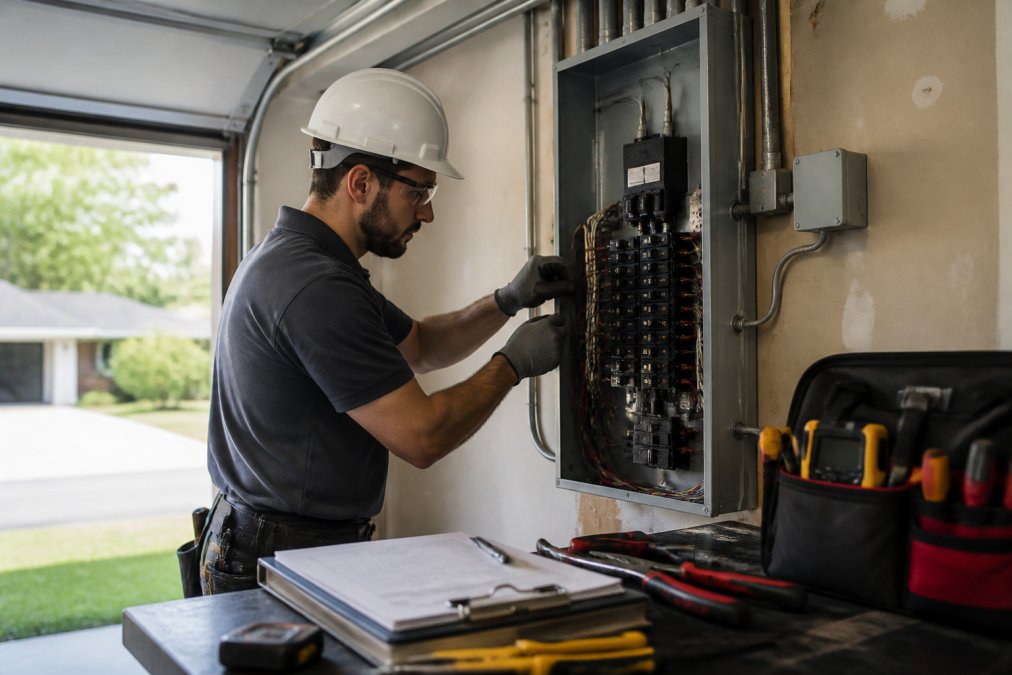
Here’s how the timeline breaks down:
- Permit application and approval (varies by jurisdiction)
- Scheduling and material staging
- Power disconnect and removal of the old panel
- Installation of the new panel, breakers, and grounding
- Inspection and power restoration
A panel relocation adds time and cost because it involves rerouting the service mast and service entrance cable.
Ask your electrician to confirm whether your utility needs to disconnect and reconnect the meter. That utility step, not the panel work itself, is often the biggest source of scheduling delay.
EV Chargers, Smart Panels, and Insurance: What Competitors Skip
Most cost guides stop at the panel. The bigger story in 2026 is what the upgrade enables: EV charger compatibility, smart panel integration, and clearer insurance implications.
An EV charger draws significant continuous load. If your panel capacity is already tight, adding a charger without a load calculation can cause nuisance tripping. A smart panel can monitor and manage that load automatically, which matters if a full service upgrade isn’t in the budget yet.
On insurance, carriers increasingly ask about panel type and age during underwriting. Replacing a known-hazard panel and keeping your electrical inspection documentation on file can simplify that conversation.
The panel upgrade isn’t the finish line. Factor in EV readiness, surge protection, and AFCI/GFCI breaker requirements so you don’t pay twice for the same wall.
Conclusion
Deciding on a panel upgrade means weighing safety, capacity, and future needs, not just the sticker price. At Accurate Electric LLC, our licensed and insured electricians bring over 31 years of combined experience to every job, delivering code-compliant solutions from panel upgrades to specialized marine and dock power installations. We handle permits, inspections, and the details that keep your home safe and insurable. Contact Accurate Electric LLC for a quote and get the capacity and peace of mind your home deserves.
Frequently Asked Questions
How much does it cost to upgrade a 100 amp electrical panel to a 200 amp panel?
The total depends on your home’s wiring, permit fees, and whether the meter socket or service mast needs replacement. A straight swap costs less than one that requires new service entrance cable or heavy-up work. Because Accurate Electric LLC has not published pricing, request a written quote that itemizes labor, materials, permit fees, and inspection costs before you commit.
Is it safe to keep a Zinsco electrical panel in my home?
Zinsco panels are widely considered a fire risk because their breakers can fail to trip during an overload, leaving circuits energized when they should shut off. Many electricians recommend replacement rather than repair. If you have a Zinsco panel, have a licensed electrician inspect it and document the condition for your insurer. An electrical panel upgrade removes the hazard and brings the system into code compliance.
Does an upgraded electrical panel increase home resale value?
An upgrade rarely adds a dollar-for-dollar return, but it can prevent deal-killers. Buyers and inspectors flag outdated panels, Federal Pacific and Zinsco boxes, and aluminum wiring. A documented, code-compliant upgrade with permits and inspection sign-off gives buyers confidence and can keep a sale from stalling during the inspection period.
What are the signs that my home needs an electrical panel upgrade?
Frequent breaker trips, flickering lights, warm panel covers, burning smells, and a panel with no spare slots all point to a capacity problem. So does adding a large load like an EV charger, tankless water heater, or generator. If your home still has a 100-amp service or outdated wiring such as knob-and-tube or aluminum, a load calculation will show whether an upgrade is needed.












continue reading
Related Posts
Compare top electrical panel brands for 2026. Find reliable options for residential upgrades, smart integration, and safety compliance.
Understand electrical panel upgrade timelines, costs, and what to expect. Learn permitting, inspection, and factors that affect duration.
Commercial electrical alternatives: Compare commercial electrical contractors in the Tampa Bay area. Find licensed alternatives for panel upgrades.
Get Social