


Table of Contents
- What Is a Surge Protective Device and Why It Matters
- Common Causes of Power Surges in Commercial Facilities
- Understanding Commercial Surge Protection Devices
- NEC Surge Protection Requirements for Commercial Properties
- Layered Protection Strategy for Maximum Equipment Safety
- Commercial Electrical Maintenance for Businesses and Surge Prevention
- Integration with Smart Building Management Systems
- ROI and Insurance Benefits of Surge Protection
- Frequently Asked Questions
Last Updated: September 22, 2026
What Is a Surge Protective Device and Why It Matters
A Surge Protective Device (SPD) protects equipment from voltage spikes by diverting excess energy to ground when lightning strikes, internal switching surges, or utility grid fluctuations occur.
Understanding surge protection isn’t optional for commercial property owners. Equipment failure from unprotected surges can halt operations, damage expensive machinery, and create safety hazards. According to the National Electrical Code (NEC) guidelines, commercial facilities must implement coordinated surge protection strategies to maintain system reliability and meet electrical safety standards.
A properly designed SPD system prevents downtime, extends equipment longevity, and protects your investment in electrical infrastructure.
Common Causes of Power Surges in Commercial Facilities
Lightning strikes introduce thousands of volts in microseconds, but internal switching surges from motors, HVAC systems, and industrial equipment occur more frequently. Understanding these sources justifies investment in preventing electrical surges across your facility.
Utility switching and equipment cycling generate repeated small surges that cumulatively stress insulation and degrade components.
Older electrical infrastructure creates vulnerability; a single unprotected surge can cascade through networked systems, affecting servers, security, HVAC, and lighting simultaneously.
Understanding Commercial Surge Protection Devices
Metal Oxide Varistors (MOVs) are the most common SPD technology; they clamp voltage by shunting excess current to ground in nanoseconds, making them ideal for whole-building protection at the service entrance.
Solid-state suppressors use semiconductor technology for faster response and lower clamping voltages at point-of-use locations. Hybrid devices combine multiple technologies for comprehensive protection.
The key specification is voltage clamping level, how much voltage the SPD allows through. Commercial applications typically target 400-600 volts for 480-volt systems, balancing protection with cost.
Impedance and conductor routing matter significantly; long wire runs reduce effectiveness. Professional installation ensures minimal wire length and proper grounding for effective response.
NEC Surge Protection Requirements for Commercial Properties
The National Electrical Code Article 285 requires surge protection at the service entrance for facilities with sensitive electronic loads, a mandatory code requirement affecting inspection compliance.
NEC requirements for preventing electrical surges mandate SPD installation on the line side of the main disconnect with proper grounding and coordination between entrance-level and point-of-use devices.
For facilities with data centers, medical equipment, or critical control systems, Article 285 requires documented surge protection coordination. A qualified electrician must verify NEC compliance.
Local amendments sometimes add stricter requirements; building departments in lightning-prone areas often mandate additional protection beyond NEC standards.
Layered Protection Strategy for Maximum Equipment Safety
Effective surge protection requires multiple layers. The layered protection strategy starts at the service entrance with a heavy-duty SPD that handles the largest surges and protects the main distribution system.
Commercial Electrical Maintenance for Businesses and Surge Prevention
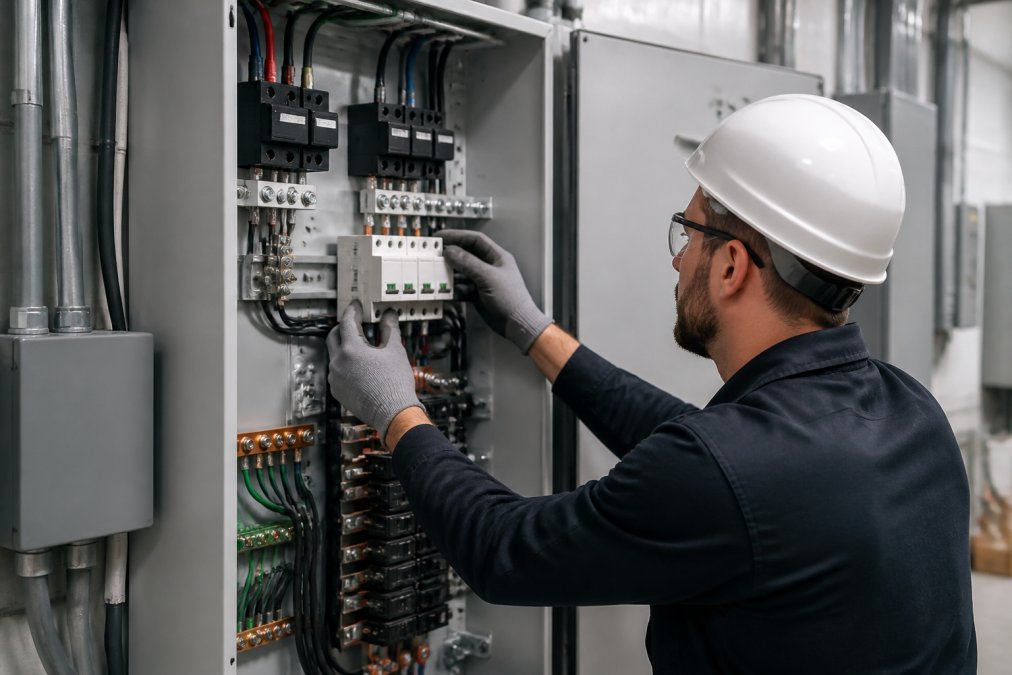
Surge protection requires ongoing maintenance and testing. SPDs degrade as they absorb surge energy; without a maintenance schedule, your facility can shift from protected to vulnerable without warning.
Quarterly Visual Inspection Protocol
Inspect SPD status indicators quarterly. Green indicates normal operation; yellow/amber signals degradation; red indicates failure. Document status and replace any non-green devices immediately.
Annual Testing and Impedance Verification
Annual testing should occur at minimum, or immediately after any known surge event. A qualified electrician measures impedance of the protection path, grounding continuity (below 0.1 ohms), and voltage clamping response to verify the SPD functions as designed.
Post-Surge Diagnostic Procedures
After any known surge event, perform comprehensive diagnostics within 24 hours: visually inspect all SPDs for damage, check connected equipment for thermal damage, verify grounding connections, and use a power quality analyzer to measure voltage levels and transient activity.
Documentation and Record-Keeping
Maintain detailed records of all surge protection activities:
- Installation records: Date installed, device model and specifications, installation location, installer name and license number.
- Maintenance logs: Dates of inspections, technician name, findings (status indicator colors, any visible damage), and actions taken.
- Testing reports: Annual test results including impedance measurements, grounding continuity readings, and voltage clamping verification.
- Surge events: Date and time of surge, apparent cause, affected equipment, damage assessment, and repairs performed.
This documentation serves multiple purposes: it demonstrates your facility’s commitment to electrical safety during insurance audits, supports insurance claims if equipment does fail, and provides historical data that helps identify patterns. For example, if your facility experiences frequent surges from a specific source, the documentation justifies investment in additional protection or equipment upgrades.
Replacement Intervals and End-of-Life Management
Most entrance-level SPDs rated for commercial service have an expected lifespan of 5-10 years depending on surge frequency and environmental conditions. Devices in facilities with frequent electrical disturbances degrade faster. Rather than waiting for failure, many facility managers replace entrance SPDs on a 7-year cycle and distribution panel devices on a 10-year cycle. This proactive approach prevents unplanned downtime.
Integration with Smart Building Management Systems
Modern commercial facilities increasingly integrate surge protection with Smart Building Management Systems (BMS). This integration provides real-time monitoring of electrical conditions and SPD performance. When a surge event occurs, the BMS logs voltage levels, duration, and affected circuits, data that helps identify recurring problems.
ROI and Insurance Benefits of Surge Protection
The financial case for surge protection rests on three pillars: equipment protection, operational continuity, and insurance cost reduction. Understanding how to calculate ROI helps facility managers justify the investment and prioritize surge protection in capital budgets.
Equipment Replacement Cost Avoidance
A single surge event can damage multiple systems simultaneously. Consider a typical commercial facility’s critical equipment:
- Servers and networking equipment: $15,000-$50,000 per unit; a data center with 20 servers faces potential losses exceeding $300,000 from a single unprotected surge.
- HVAC control systems: $5,000-$15,000 per unit; larger facilities may have multiple systems.
- Security and access control systems: $10,000-$30,000 for comprehensive systems.
- Lighting management and automation: $20,000-$100,000 depending on facility size.
- Industrial machinery and motors: $50,000-$500,000+ for manufacturing equipment.
Business Interruption and Revenue Loss Prevention
Downtime costs extend beyond equipment replacement. When electrical surges disable critical systems, operations stop:
- Retail facilities: Average loss of $1,000-$5,000 per hour of downtime due to lost sales and customer disruption.
- Data centers and hosting providers: $5,600-$15,000 per minute of downtime (based on industry surveys); a one-hour outage costs $336,000-$900,000.
- Medical offices and clinics: Patient care disruption, rescheduled appointments, and potential liability for missed treatments.
- Manufacturing facilities: Production line shutdowns cost $10,000-$100,000+ per hour depending on operation scale.
Insurance Premium Reduction Framework
Insurance companies recognize surge protection as a risk mitigation measure. Many commercial property insurers offer premium reductions for facilities with documented surge protection systems. The reduction typically ranges from 5-15% of annual property insurance premiums, depending on the insurer and facility risk profile.
Calculating potential insurance savings:
- Determine your current annual property insurance premium (review your policy documents).
- Request a quote from your insurer that includes a discount for surge protection installation. Most insurers require documentation of the SPD system: installation date, device specifications, maintenance records, and annual testing results.
- Calculate the annual savings: (Current Premium) × (Discount Percentage) = Annual Savings.
- Divide the surge protection system cost by annual savings to determine payback period.
Example calculation:
- Current annual property insurance premium: $50,000
- Insurer offers 10% discount for documented surge protection: $5,000 annual savings
- Surge protection system cost: $20,000 installed
- Payback period: $20,000 ÷ $5,000 = 4 years
- After 4 years, the system generates pure savings
Sector-Specific ROI Considerations
Data Centers and Server Facilities:
These facilities face the highest surge risk due to sensitive electronics and continuous operation. A single surge can damage multiple servers simultaneously. Data centers typically recover surge protection investment within 6-12 months through avoided equipment replacement and prevented downtime. Insurance discounts add additional savings.
Creating a Surge Protection ROI Analysis for Your Facility
To justify surge protection investment to stakeholders:
- Inventory critical equipment: List servers, machinery, control systems, and other equipment vulnerable to surge damage. Research replacement costs.
- Estimate downtime costs: Calculate hourly revenue loss or operational impact if critical systems fail.
- Assess historical surge events: If your facility has experienced surge damage, use actual repair costs and downtime as evidence.
- Obtain insurance quotes: Request quotes from your property insurer showing the discount for surge protection installation.
- Calculate multiple scenarios: Show ROI based on equipment protection alone, insurance savings alone, and prevented downtime alone. Most facilities will see positive ROI under any scenario.
- Document the analysis: Present findings to facility management and decision-makers with specific numbers relevant to your operation.
Most commercial facility managers find that surge protection represents one of the highest-return electrical investments available, with payback periods of 2-5 years and ongoing insurance savings that extend the benefit indefinitely.
Frequently Asked Questions
What are the main causes of electrical surges in commercial buildings?
Electrical surges occur from three primary sources: lightning strikes that enter through utility lines, internal switching surges from large equipment cycling on and off, and utility company switching events. Lightning is the most dramatic cause but affects buildings infrequently. Internal surges from motors, HVAC systems, and compressors happen regularly and cause cumulative damage to sensitive electronics. Understanding these sources helps justify the investment in preventing electrical surges through multi-layer protection at the service entrance and point-of-use locations.
What do NEC surge protection requirements specify for commercial properties?
The National Electrical Code (NEC) requires surge protective devices at the service entrance for facilities with sensitive electronic equipment, data centers, or systems requiring high availability. The NEC establishes standards for surge protection installation, grounding, and conductor routing. Specific NEC surge protection requirements depend on your facility type and equipment. A licensed electrician can assess your property and ensure compliance with current code, protecting both your equipment and your liability.
How often should commercial surge protection systems be inspected?
Surge protective devices should be inspected annually as part of your commercial electrical maintenance for businesses. After a lightning storm or significant power event, immediate inspection is critical to verify the SPD responded correctly and remains functional. Many modern devices include status indicators showing whether they’ve been compromised. Regular maintenance schedules help catch degraded MOV (Metal Oxide Varistor) components before they fail, ensuring continuous protection for your sensitive electronics and reducing facility downtime risk.
Can a power surge damage equipment even with surge protection installed?
Yes, but properly installed surge protection significantly reduces risk. A single surge protective device cannot catch every transient voltage spike, especially at point-of-use locations far from the service entrance. This is why a layered protection strategy, combining service entrance SPDs with point-of-use protection and proper grounding, provides the best defense. Even with these safeguards, extremely severe lightning strikes or multiple simultaneous surges can overwhelm protection. However, layered protection dramatically improves equipment longevity and reduces the frequency and severity of damage.












continue reading
Related Posts
Commercial electrical alternatives: Compare commercial electrical contractors in the Tampa Bay area. Find licensed alternatives for panel upgrades.
Find top residential electrical safety inspection services. Compare licensed contractors, learn what inspections cover, and discover red flags. Get expert.
Learn about residential panel upgrades: costs, safety risks, permits, and how to choose a licensed electrician. Get expert guidance today.
Get Social