


Table of Contents
- What Makes a Dock Power Installation Service Reliable
- Marine Electrical Code Requirements for Docks
- GFCI Protection for Boat Docks: Why It Matters
- Shore Power Pedestal Installation Cost and Considerations
- Key Features to Compare in Dock Power Installation Providers
- Electric Shock Drowning Prevention and Safety Standards
- DIY vs. Professional Installation: What You Need to Know
- Frequently Asked Questions
Last Updated: September 20, 2026
What Makes a Dock Power Installation Service Reliable
A reliable dock power installation service combines technical expertise, strict adherence to safety codes, and marine environment experience. Amateurs leave corroded connections, failed GFCI breakers, and unsafe wiring that create liability and risk.
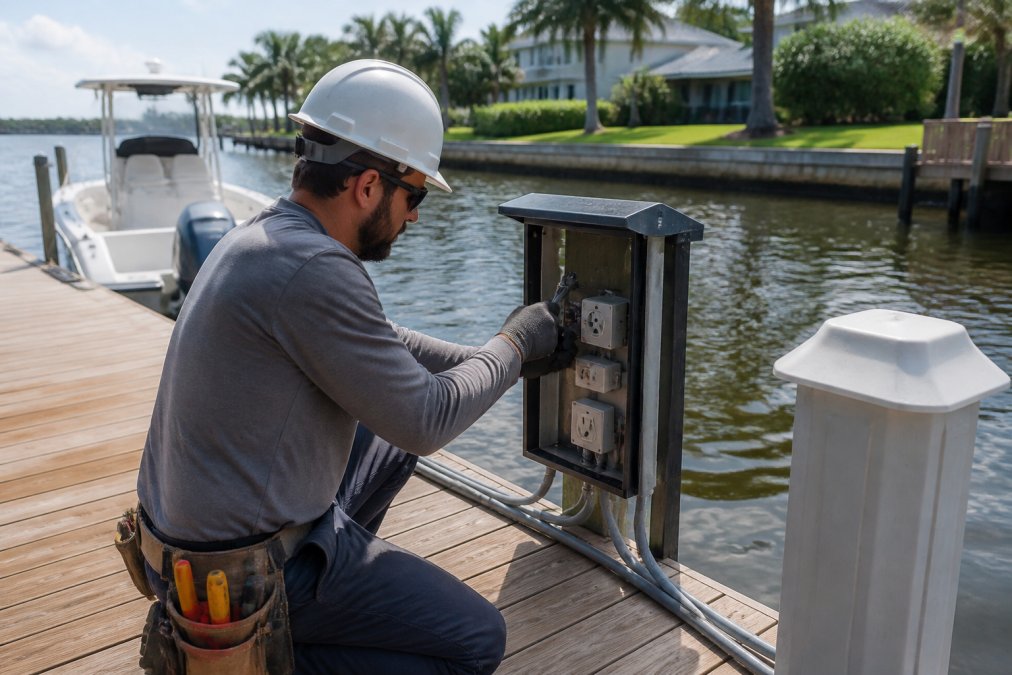
The best dock power installation services understand marine-specific challenges: saltwater accelerates corrosion, moisture demands waterproof enclosures, and boat power requirements differ from residential circuits. Standard residential practices will fail on a dock.
Accurate Electric LLC brings over 31 years of combined industry experience to dock power projects. Our licensed and insured electricians understand that dock power installation services require specialized knowledge, from shore power pedestal selection to GFCI protection configuration to proper grounding and bonding in saltwater conditions. We ensure every dock power installation meets or exceeds code while accounting for the unique demands of waterfront environments.
The best providers obtain licensed electrical inspections, provide code compliance documentation, and communicate clearly about timelines, costs, and limitations.
Marine Electrical Code Requirements for Docks
Marine electrical code requirements for docks fall under NEC Article 555, which governs marinas and boatyards. These standards prevent electrocution, fire, and property damage. Article 555 is more stringent than residential code (Article 210) because saltwater and water proximity demand additional safeguards.
GFCI Protection and Outlet Requirements
The NEC requires that all dock outlets be protected by Ground Fault Circuit Interrupter (GFCI) devices rated for marine use. Every outlet within 10 feet of water must have GFCI protection, no exceptions. This includes outlets on the dock itself, on shore power pedestals, and on any structures (boat lifts, floating docks, piers) that extend into or over water.
All dock circuits must be individual branch circuits protected by GFCI breakers or GFCI outlets. A common mistake is installing a single GFCI outlet at the circuit’s beginning, assuming it protects all downstream outlets. This creates a single point of failure. Best practice is GFCI protection at every outlet or a GFCI breaker protecting the entire circuit for redundancy.
Outlets must be rated for wet locations and installed in weatherproof enclosures. Standard residential outlets corrode within months in dock environments. Marine-rated outlets use stainless steel or powder-coated brass components and gasket seals to prevent water intrusion.
Conduit Material Selection and Saltwater Durability
All wiring in dock areas must be marine-grade, meaning it’s designed to resist saltwater corrosion and moisture penetration. The conduit that houses the wiring is equally critical, and material selection directly determines how long your installation will remain safe and functional.
Galvanized Steel Conduit: Galvanized coatings fail in saltwater within 3-7 years. Once the zinc corrodes, rust penetrates the steel, allowing water to contact wire insulation and cause short circuits, ground faults, and GFCI nuisance trips. Galvanized conduit is not recommended within 500 feet of saltwater and has been removed from some jurisdictions’ approved materials lists.
PVC Conduit: PVC is the most common choice for modern dock installations and is approved by NEC Article 555 for wet locations. It resists saltwater corrosion indefinitely, requires no maintenance, and costs less than stainless steel. Schedule 40 PVC suits above-ground protected runs; Schedule 80 (thicker-walled) is required for areas subject to mechanical stress. PVC’s main limitation is UV degradation over 10-15 years; above-ground runs should be painted with UV-protective coating or buried. Underground PVC lasts 50+ years in saltwater.
Stainless Steel Conduit: 316-grade stainless steel is the premium option for high-salinity or aggressive environments. It resists corrosion indefinitely, maintains flexibility in cold weather, and requires no maintenance. Stainless costs 4-5 times more than PVC but is best for docks near ocean inlets or where maximum durability is priority. Many installations use stainless for above-ground runs and PVC for underground sections.
Grounding and Bonding Standards
Grounding and bonding standards are stricter for docks than residential installations. All metal structures, pilings, railings, boat lift frames, ladder rungs, gates, must be bonded together and connected to proper ground to prevent shock hazards in water. Use marine-grade copper or tinned copper conductors (never aluminum). All connections must use stainless steel hardware and marine-grade sealant. A single corroded connection compromises the entire system.
The ground electrode system must extend below the water table or into saltwater if the dock is over tidal water. A ground rod driven into dry soil is insufficient.
Inspection and Permitting Requirements
Most municipalities require a licensed electrical inspection before dock power systems become operational. The inspector verifies GFCI protection, grounding and bonding, conduit material and sealing, wire gauge, circuit breaker sizing, and documentation. Skipping inspection creates liability and may void insurance. A legitimate dock power installation service obtains permits and schedules inspection as part of the project.
GFCI Protection for Boat Docks: Why It Matters
GFCI protection prevents electric shock drowning (ESD), where electrical current causes muscle paralysis and drowning at levels far below what standard breakers detect. Standard breakers respond to overcurrent; GFCI devices detect tiny current imbalances (as little as 5 mA) and shut off power in milliseconds, preventing cardiac arrhythmia or muscle paralysis.
Shore Power Pedestal Installation Cost and Considerations
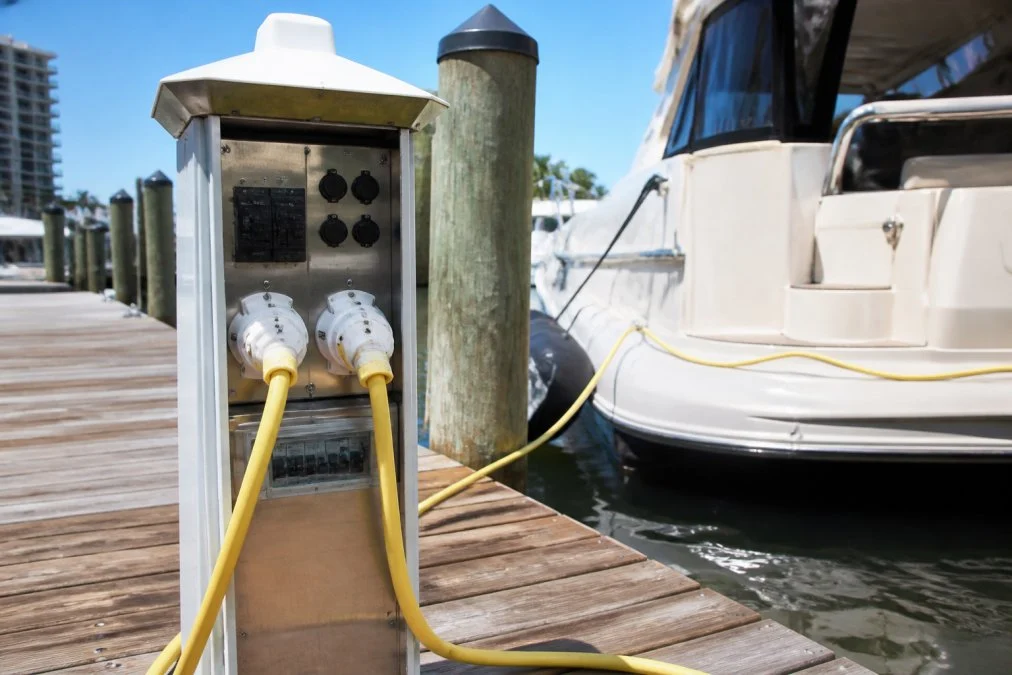
Shore power pedestals are weatherproof enclosures containing circuit breakers, outlets, and metering equipment. They distribute power safely to boats and dock equipment while withstanding wind, spray, and temperature extremes.
Pedestal Selection and Amperage Requirements
Pedestal selection depends on several factors: the number of boats served, the amperage requirements, whether you need 120V only or 120/240V service, and your budget. A basic single-outlet pedestal with two 30-amp circuits serves smaller residential docks with one or two boats. Multi-outlet pedestals with 50-amp service accommodate larger docks or multiple vessels. Some installations require 100+ amps if the dock includes shore power for multiple boats plus dedicated circuits for dock lighting, refrigeration, or equipment.
Installation Cost Breakdown
Total dock power installation costs depend on complexity, materials, and specific site conditions. A professional service performs load calculations based on your actual equipment and usage patterns, not assumptions.
Material Durability and Corrosion Resistance
Conduit material choice directly affects long-term reliability and maintenance costs. Galvanized steel corrodes in saltwater within 3-7 years and costs $8-$12 per 10-foot section but requires replacement within a decade. PVC resists saltwater indefinitely, costs $12-$18 per section, requires no maintenance, but becomes brittle below 0°F and degrades under UV exposure if not painted or buried; underground PVC lasts 50+ years.
Installation Timeline and Site Conditions
Installation typically takes one to two days for straightforward pedestal replacement. Underground conduit trenching adds 1-2 days; structural modifications add 1-3 days; service panel upgrades can add weeks; permitting delays typically require 1-2 weeks. Plan for service interruptions during installation if you rely on dock power for security lighting or refrigeration.
Key Features to Compare in Dock Power Installation Providers
When evaluating dock power installation services, verify: Licensed and Insured Status (active electrical contractor license and liability insurance); Code Compliance Documentation (permits and licensed inspections); Marine-Specific Experience (GFCI protection, shore power pedestals, corrosion-resistant materials, saltwater environments); Warranty and Follow-up (materials and labor warranties, maintenance programs); Communication and Timeline (clear explanations, upfront discussion of complications and costs).
| Feature | Why It Matters | What to Look For |
|---|---|---|
| Licensed electrician | Ensures code compliance and legal liability coverage | Active state license; ask for license number |
| GFCI expertise | Prevents electric shock drowning | Experience with Class A GFCI for docks |
| Marine-grade materials | Resists saltwater corrosion | PVC conduit, stainless hardware, waterproof enclosures |
| Permit and inspection coordination | Verifies safety; protects your insurance | Provider obtains permits and schedules inspection |
| Maintenance programs | Catches failures before they cause hazards | Annual or semi-annual inspection offered |
Electric Shock Drowning Prevention and Safety Standards
Electric shock drowning (ESD) occurs when electrical current causes muscle paralysis, preventing swimming or calling for help. Even 10 mA can cause involuntary contractions. ESD happens silently: a person in the water near faulty wiring or a failed GFCI may feel tingling, lose muscle control, and slip underwater. Prevention depends on three layers: grounding and bonding to eliminate voltage differences in water; GFCI protection to shut off power before harmful current flows; and regular maintenance to catch failing components.
DIY vs. Professional Installation: What You Need to Know
DIY dock electrical work violates most jurisdictions’ code requirements for licensed electricians and may void homeowner’s insurance. Marine electrical systems demand specialized knowledge; mistakes in grounding, bonding, GFCI configuration, or conduit sealing create hazards that won’t be obvious until someone is hurt. If someone is injured by a system you installed, you’re personally liable and insurance likely won’t cover unpermitted electrical work. Professional installation costs less than the risk.
Frequently Asked Questions
What are the NEC requirements for dock power installations?
The National Electrical Code (NEC) requires dock power installations to include GFCI protection on all outlets, proper grounding and bonding systems, and marine-grade wiring rated for saltwater environments. All installations must comply with Article 555 of the NEC, which governs marinas and boatyards. Licensed electricians ensure your dock power installation meets these standards through proper conduit installation, waterproof enclosures, and circuit breaker sizing based on load calculations. Local inspection and permits are mandatory.
Do I need a licensed electrician for boat dock wiring?
Yes. Dock electrical work requires a licensed electrician due to the specialized hazards of waterfront environments and NEC code compliance. Marine-grade electrical installations involve corrosion-resistant materials, proper grounding in saltwater conditions, and GFCI protection that prevent electric shock drowning. Attempting DIY dock wiring violates electrical codes, voids permits, and creates serious safety risks. Licensed professionals carry liability insurance and guarantee code-compliant work.
What is the difference between shore power and standard dock power?
Shore power systems deliver 120/240-volt service from a dock power pedestal directly to a boat, allowing vessels to operate onboard systems without running engines. Standard dock power refers to general electrical service for dock lighting, outlets, and equipment. Shore power requires specialized marine-grade cables, weatherproof connectors, and dedicated circuit protection. Both require GFCI protection and proper grounding, but shore power demands higher amperage capacity and corrosion-resistant materials designed for direct boat connection.
How often should marine electrical systems be inspected?
Marine electrical systems should be inspected annually, especially before the boating season. Saltwater environments accelerate corrosion of wiring, connections, and components. Professional electrical safety inspections check for galvanic corrosion, loose connections, deteriorated insulation, and GFCI functionality. After severe weather or if you notice flickering lights, tripped breakers, or corroded connections, schedule an inspection immediately. Preventative maintenance catches hazards before they become dangerous or expensive.












continue reading
Related Posts
Commercial electrical alternatives: Compare commercial electrical contractors in the Tampa Bay area. Find licensed alternatives for panel upgrades.
Find top residential electrical safety inspection services. Compare licensed contractors, learn what inspections cover, and discover red flags. Get expert.
Preventing electrical surges: Learn how to prevent electrical surges in commercial buildings with layered protection strategies, NEC compliance.
Get Social