


Table of Contents
- Why Your Lights Dim When the Air Conditioner Starts
- Is Brief Dimming Normal or a Warning Sign?
- When Lights Flicker When Air Conditioner Starts: Common Electrical Faults
- How to Stop Lights from Dimming When AC Starts
- When to Call an Electrician for Flickering Lights
- What Professional Diagnosis and Repair Involve
- Frequently Asked Questions
Last Updated: October 20, 2026
Why Your Lights Dim When the Air Conditioner Starts
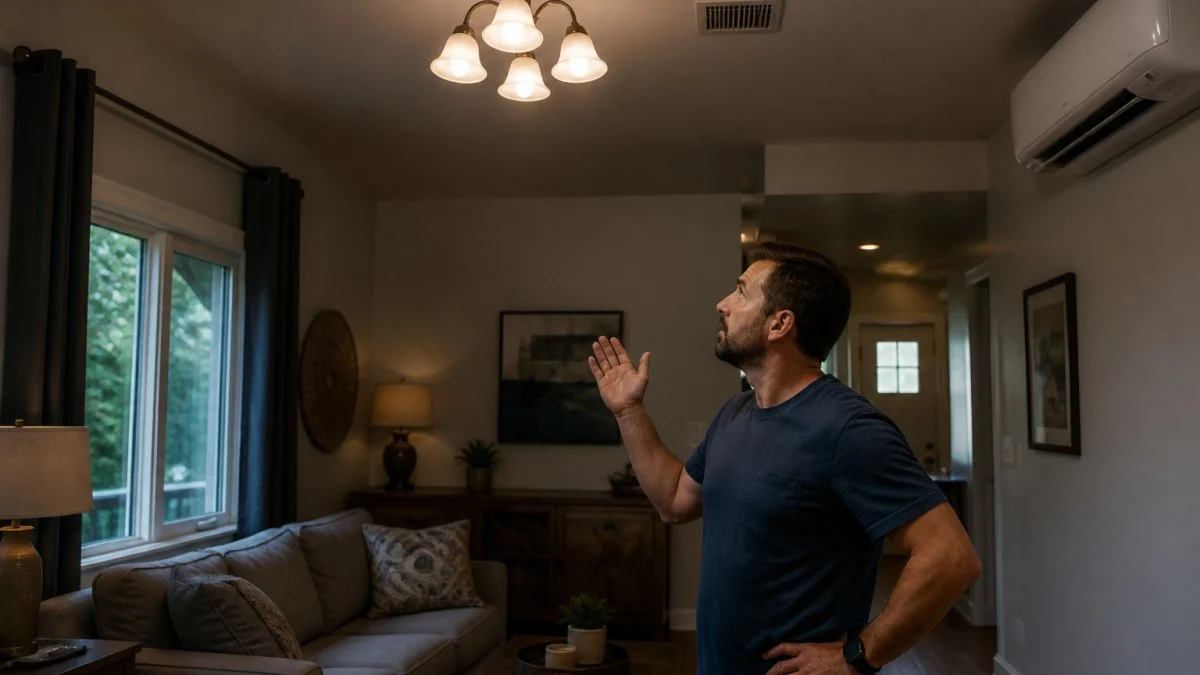
When your AC kicks on, your lights flicker or dim, a phenomenon known as lights dim when AC starts.
Lights dim when AC starts because the compressor uses a huge burst of electricity to start. This sudden demand pulls power away from your lights and other circuits, so they dim instantly.
This is called an inrush current or startup surge. It lasts only a few seconds, and the compressor draws far more power starting than running normally, like a car engine using more fuel to start than to cruise.
Most dimming is harmless. But sometimes it signals something that needs fixing.
The AC Compressor’s Startup Surge
Your AC compressor needs a massive amount of electricity to start, the motor must overcome friction and pressure to begin rotating.
A typical AC compressor draws 3 to 5 times its normal running current when it starts.
Why does this happen? Electric motors create a magnetic field that spins a rotor. Starting from a dead stop means breaking through static friction and refrigerant pressure, which demands extra current in those first moments.
Modern AC units are designed for this startup surge, and your electrical panel should handle it. But older homes or undersized systems sometimes struggle.
Voltage Drop and Electrical Load
Voltage drop is what causes the dimming. It’s the decrease in electrical pressure as current flows through your home’s wiring.
Electricity travels from the utility through your meter into your electrical panel, then splits into circuits.
LED bulbs are especially sensitive to voltage drops. They dim more noticeably than old incandescent bulbs. If you have mostly LED lights, you’ll see dimming more clearly when the AC starts.
Your home’s total electrical load also matters. If you’re running the dishwasher, dryer, and water heater when the AC compressor starts, the load is high and the voltage drop is more noticeable.
Is Brief Dimming Normal or a Warning Sign?
Most brief dimming when the AC starts is completely normal, don’t worry about a quick flicker lasting 1 to 3 seconds.
Normal dimming looks like this:
- Lights dim for 1 to 3 seconds when the AC compressor starts
- Dimming is noticeable but not extreme
- Lights return to full brightness quickly
- No other appliances are affected
- No burning smell or unusual sounds
Warning signs that need professional attention:
- Lights flicker continuously while the AC is running
- Dimming lasts longer than 5 seconds
- Dimming is severe (lights drop to half brightness or lower)
- Other appliances turn off or reset
- You hear buzzing, crackling, or popping sounds
- You smell burning or melting plastic
- Lights dim even when the AC is not starting
Continuous flickering is different from brief dimming. Brief dimming is a voltage drop; persistent flickering usually signals an electrical fault from loose connections, undersized circuits, or failing equipment.
If your lights flicker continuously or dim severely when the AC runs, do not ignore it. Persistent electrical faults can cause overheating, fire risk, or damage to your appliances. Contact a licensed electrician for diagnosis.
When Lights Flicker When Air Conditioner Starts: Common Electrical Faults
Persistent flickering signals an actual problem in your electrical system or AC equipment.
Loose Neutral Symptoms and Connection Problems
A loose neutral connection is one of the most common causes of flickering lights. The neutral wire carries return current back to the utility; if it’s loose anywhere, voltage becomes unstable, so your lights flicker unpredictably, sometimes severe, sometimes mild.
Where can a neutral connection come loose?
- At the utility company’s connection to your home
- Inside your electrical meter
- At the main breaker in your electrical panel
- At individual circuit breakers
- Inside outlets or light fixtures
- Where the neutral wire connects to the neutral bus bar in the panel
Loose connections generate heat, you might smell burning or see scorch marks. This is a fire hazard requiring immediate professional attention.
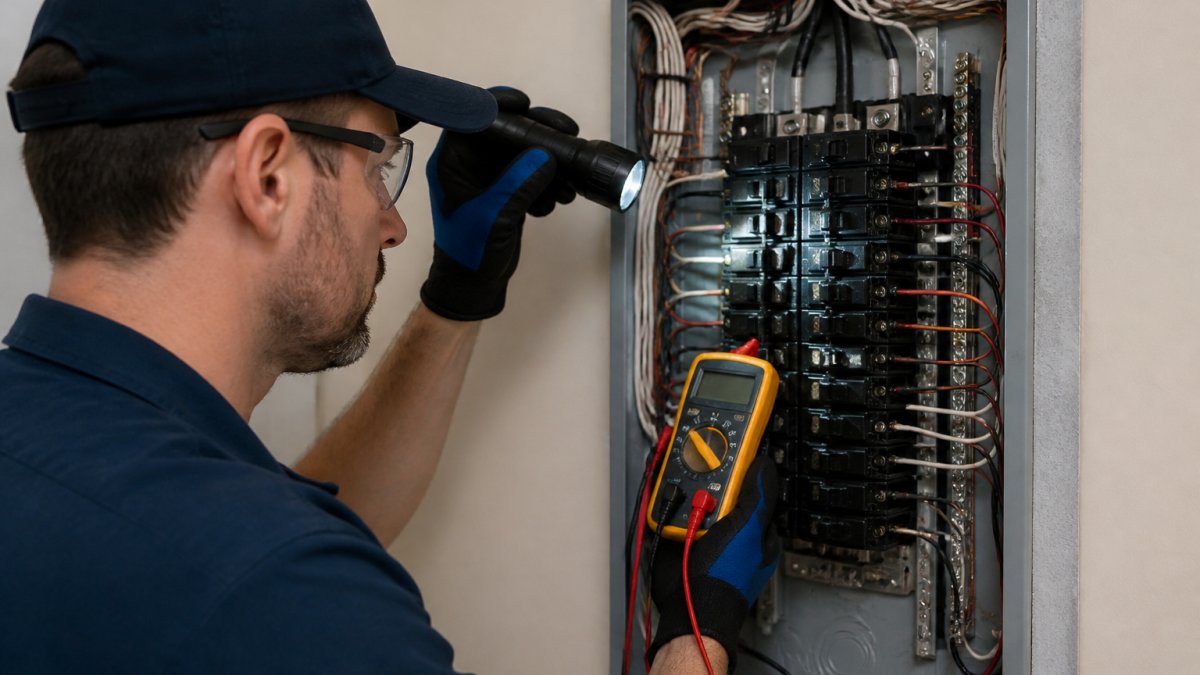
How to spot loose neutral symptoms:
- Lights flicker randomly, not just when AC starts
- Some appliances work fine while others act up
- Voltage readings are inconsistent
- Burning smell near the panel or meter
- Scorch marks or discoloration on wires or connections
Undersized Electrical Service or Circuit Capacity Issues
If your home has insufficient electrical capacity, the AC startup surge can overwhelm it. Older homes often have 100-amp service; modern homes typically have 200-amp.
A 100-amp service may handle basic loads, but add central AC, a heat pump, an EV charger, or a large water heater and you’ve exceeded design capacity, the compressor’s startup surge pushes it past its limits.
Signs of undersized service:
- Lights dim whenever multiple appliances run together
- Breakers trip frequently
- The main breaker feels warm to the touch
- Your electrical panel is from the 1980s or earlier
- You’ve added major appliances but never upgraded service
A dedicated circuit for your AC is ideal, it ensures the compressor gets power without competing with other loads, but many older homes lack one.
AC Component Faults: Capacitor and Compressor Problems
Your AC has capacitors that help the compressor and fan motor start smoothly. A start capacitor gives an extra boost during startup; a run capacitor keeps the compressor running efficiently.
Failing capacitors cause hard starting. The compressor struggles, draws even more current than normal, and creates a larger voltage drop, so your lights dim more noticeably or flicker.
Signs of a failing capacitor:
- AC takes a long time to start
- Humming sound from the outdoor unit but compressor doesn’t start
- Lights dim severely when AC tries to start
- AC cycles on and off frequently
- Outdoor unit feels very hot
A failing compressor itself can also cause problems. As the compressor ages, internal wear increases friction. The motor draws more starting current. Voltage drop increases.
Signs of a failing compressor:
- AC doesn’t cool as well as it used to
- Compressor makes grinding or clicking sounds
- Lights flicker or dim severely when AC starts
- AC cycles on and off more than usual
- Outdoor unit vibrates excessively
Capacitors are relatively inexpensive to replace. A failing compressor is more costly. Either way, an HVAC technician should diagnose the problem.
How to Stop Lights from Dimming When AC Starts
If the dimming bothers you or if it signals a real problem, there are steps to take.
Safe Homeowner Checks
You can perform some basic checks yourself. These are safe and require no special tools.
Check 1: Look at your electrical panel.
Your panel should be in a dry, accessible location. Open the door and look inside.
Check 2: Feel the panel and meter.
Turn off the main breaker and wait 10 seconds. Then carefully touch the outside of the panel and meter with the back of your hand.
Check 3: Check your breakers.
Look at each breaker in your panel.
Check 4: Inspect visible wiring.
If you can see any wiring in your home, look for damage. Wires should have intact insulation.
Check 5: Listen and smell.
When the AC starts, listen for unusual sounds. Buzzing, crackling, or popping is not normal. Burning or melting plastic smell is definitely not normal.
Check your home’s electrical panel during the day when the AC is running hard. A warm panel is normal. A hot panel is a warning sign. If you’re unsure, it’s better to have a professional check it.
When Professional Diagnosis Is Required
Some problems require professional tools and expertise. A licensed electrician can measure voltage, test capacitors, and inspect equipment you can’t safely access.
Call an electrician if:
- Lights flicker continuously or dim severely
- You see scorch marks or damage in the panel
- The panel or meter feels hot
- You smell burning or melting plastic
- Breakers trip frequently
- The dimming is getting worse over time
- You’ve added major appliances and want to verify your service capacity
- Your home is older than 30 years and has never had an electrical inspection
An electrician will use a multimeter to measure voltage at different points in your system. They’ll inspect connections for corrosion or looseness. They’ll test capacitors and compressors. They’ll identify the root cause.
When to Call an Electrician for Flickering Lights
Brief dimming when the AC starts is usually not an emergency. But persistent flickering or severe dimming needs professional attention soon.
Call an electrician today if:
- Lights flicker while the AC is running
- Dimming is severe (lights drop significantly)
- Other appliances turn off or reset
- You see or smell signs of damage
- Breakers trip frequently
- The problem is getting worse
Call an electrician this week if:
- Your home is older than 40 years
- You’ve never had an electrical inspection
- You’ve added major appliances recently
- You want to understand your system’s capacity
- You’re planning to add an EV charger or other high-power equipment
Schedule an inspection if:
- You’re curious about your electrical system’s health
- You want to know if your service is adequate
- You’re considering upgrades or renovations
- You want peace of mind
We measure voltage, test equipment, and identify the real cause. Then we explain your options.
What Professional Diagnosis and Repair Involve
A professional electrician follows a systematic process to find and fix electrical problems.
Step 1: Interview and observation.
The electrician asks questions. When did the problem start? Does it happen every time the AC runs? Have you made any recent changes?
Step 2: Voltage measurement.
Using a multimeter, the electrician measures voltage at different locations:
- At the main panel
- At individual outlets
- At the AC disconnect switch
- Inside the AC unit
They record these measurements during AC startup. This shows exactly how much voltage drops and where.
Step 3: Visual inspection.
The electrician inspects:
- All connections in the electrical panel
- The meter and utility connection
- Visible wiring for damage or corrosion
- The AC disconnect switch and capacitors
- Breakers for signs of overheating
Step 4: Testing and diagnosis.
Based on measurements and inspection, the electrician determines the cause:
- Is it normal voltage drop from startup surge?
- Is there a loose connection?
- Are capacitors failing?
- Is the service undersized?
- Is the compressor failing?
Step 5: Recommendation and repair.
The electrician explains the problem in plain language. They recommend a solution. Options might include:
- Tightening loose connections
- Replacing capacitors
- Adding a dedicated circuit for the AC
- Upgrading electrical service
- Referring you to an HVAC technician for compressor issues
Brief dimming when your AC starts is normal in most homes.
Persistent flickering or severe dimming is different. It signals a real electrical problem. Loose connections, undersized service, or failing equipment cause these issues.
At Accurate Electric LLC, we diagnose electrical problems accurately and fix them right. Our licensed electricians have over 31 years of combined experience.
Frequently Asked Questions
Is it normal for lights to dim briefly when the air conditioner starts?
Yes, brief dimming lasting a second or two is normal when your AC compressor starts. The compressor draws a large inrush current that temporarily increases electrical load on your home’s power supply, causing a temporary voltage drop that affects lights and other appliances. However, if dimming is severe, lasts more than a few seconds, or happens repeatedly, it signals an underlying electrical problem that needs professional attention.
What are loose neutral symptoms in electrical systems?
A loose neutral connection causes voltage fluctuations throughout your home, leading to persistent flickering lights, dimming that worsens when the AC starts, buzzing sounds near outlets, or appliances running poorly. You may also notice burning smells near the electrical panel or outlets. A loose neutral is a serious fire hazard and requires immediate attention from a licensed electrician, do not attempt repairs yourself.
How can I tell if my electrical panel has enough capacity for my AC?
Most modern homes have 200-amp service, which should handle standard air conditioners. However, if your home is older, has a smaller service (100-amp or less), or you’ve added high-demand appliances like EV chargers or pool pumps, your panel may lack sufficient capacity. An electrician can measure voltage during AC startup and inspect your breaker and circuit capacity to determine if an upgrade is needed.
Can a weak capacitor or failing compressor cause lights to dim when the AC starts?
Yes. A failing start capacitor prevents the compressor from reaching full speed efficiently, causing it to draw excessive current during startup, this increases voltage drop and intensifies dimming. A weak compressor motor has similar effects. If dimming worsens over time or your AC runs longer than usual, have an HVAC technician inspect the capacitor and compressor before the system fails completely.












continue reading
Related Posts
Compare top electrical panel brands for 2026. Find reliable options for residential upgrades, smart integration, and safety compliance.
Understand electrical panel upgrade timelines, costs, and what to expect. Learn permitting, inspection, and factors that affect duration.
Commercial electrical alternatives: Compare commercial electrical contractors in the Tampa Bay area. Find licensed alternatives for panel upgrades.
Get Social