


Table of Contents
- What You’ll Need Before You Start Troubleshooting
- Common EV Charger Tripping Breaker Causes
- How to Troubleshoot an EV Charger Circuit Step by Step
- EV Charger GFCI Breaker Requirements Explained
- Signs of a Faulty Circuit Breaker vs. a Charger Problem
- Breaker Age, Environmental Factors, and Nuisance Tripping
- When to Call a Licensed Electrician for EV Charger Tripping
- Frequently Asked Questions
Last Updated: September 16, 2026
What You’ll Need Before You Start Troubleshooting
An EV charger tripping breaker causes range from a loose terminal screw to a breaker that has aged out, and sorting one from the other starts with knowing your setup. This guide from Accurate Electric LLC walks through the diagnostic sequence our electricians use in the field, from the first visual check to the point where a licensed pro takes over.
Here is what to have on hand:
- The charger’s manual and its rated amperage
- The breaker size printed on the panel label
- A note of when the trips happen (always, or only with other appliances running)
- A flashlight and a non-contact voltage tester
Common EV Charger Tripping Breaker Causes
Most EV charger tripping breaker events trace back to loose wiring connections, an undersized breaker, a sensitive GFCI, corrosion, or a failing charger. The chart below maps each cause to its symptom and fix.
| Cause | Typical Symptom | Fix |
|---|---|---|
| Loose terminal | Trips after minutes of charging | Torque connections to spec |
| Undersized breaker | Trips under continuous load | Load calculation, correct breaker |
| Nuisance GFCI trip | Trips in rain or damp air | Verify GFCI type and wiring |
| Corrosion | Intermittent trips, warm plug | Clean or replace contacts |
| Aging breaker | Random trips, no pattern | Replace the breaker |
Loose Electrical Connections and Heat Buildup
A loose terminal is the most common cause we find. Resistance at a loose connection converts current into heat, which builds until the breaker’s thermal element trips. The connection may look fine from the outside.
Signs to watch for:
- A warm or discolored breaker face
- A burning smell near the panel or receptacle
- Trips that happen after 20-40 minutes of charging, not immediately
Circuit Breaker Sizing and Load Capacity
An EV charger draws a continuous load, which the National Electrical Code treats differently from intermittent loads. A 40-amp charger typically sits on a 50-amp breaker because the circuit must be sized for that continuous draw. If the breaker is undersized or the panel is near capacity, the charger will trip it every time.
How to Troubleshoot an EV Charger Circuit Step by Step
Work through these steps in order, and call a licensed electrician at any point where you would need to open the panel or work inside the charger.
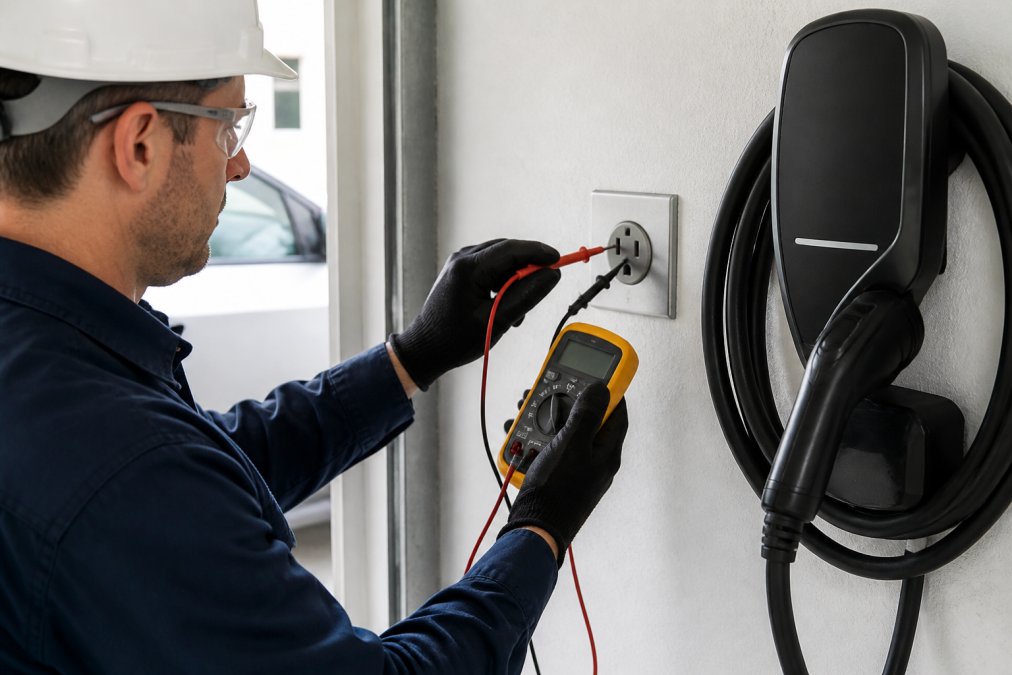
- Reset the breaker once. If it holds, note how long before it trips again.
- Check the charger’s error log. Many units store fault codes that name the exact condition.
- Reduce the charger’s current setting. Lower the amperage and retest.
- Unplug other large loads. Run the charger alone to isolate an overload.
- Inspect the receptacle and plug. Look for discoloration, scorching, or a loose fit.
- Feel the breaker face. Warmth points to a loose connection or an overloaded circuit.
- Test with a different circuit if one is available. This separates a charger fault from a circuit fault.
Never “fix” a tripping breaker by installing a larger one. Oversizing the breaker removes the protection the circuit was designed around and creates a genuine fire risk.
EV Charger GFCI Breaker Requirements Explained
EV charger GFCI breaker requirements exist because charging equipment sits in garages and driveways where moisture and ground faults are real hazards. A GFCI trips when current leaks to ground, protecting people from shock, which is why it trips on conditions a standard breaker would ignore.
Two code facts drive most of the confusion:
- Since the 2020 edition of the National Electrical Code, 240-volt receptacles in garages, outdoors, and other damp or wet locations generally require GFCI protection. The 2023 edition tightened this further. That means many NEMA 14-50 outlets installed for EV charging now sit behind a GFCI breaker even when the charger itself has ground fault protection built in.
- Hardwired chargers are treated differently from plug-in chargers under the code, which is why two neighbors with identical cars can have completely different breaker setups.
Four failure modes cause most GFCI nuisance trips:
- Shared neutral or miswired ground. A ground and neutral bonded in the wrong place makes the GFCI see a current imbalance that is not actually flowing to earth.
- Moisture in the receptacle. Damp air, rain, or a hose spray can trip a sensitive GFCI even when the wiring is sound. This is why trips cluster after storms.
- Charger leakage current. Electronics in the charger can leak a milliamp or two to ground, and that stacks on top of any wiring leakage.
- Long circuit runs. Voltage drop and capacitance on a long run from panel to garage can add to the leakage the GFCI sees.
U.S. Department of Energy guidance on home EV charging
Signs of a Faulty Circuit Breaker vs. a Charger Problem
Telling a faulty circuit breaker apart from a charger fault comes down to the trip pattern. A breaker that trips randomly, regardless of load, is usually the breaker. A charger that trips on multiple circuits is usually the charger.
| Signal | Points To |
|---|---|
| Trips with no load connected | Breaker or wiring fault |
| Trips only during charging | Charger or overload |
| Trips on any circuit | Charger fault |
| Trips in damp weather | GFCI or moisture |
| Breaker warm to the touch | Loose connection |
Breaker Age, Environmental Factors, and Nuisance Tripping
Age and environment drive more “nuisance” trips than most homeowners realize. Three factors deserve a closer look: thermal fatigue in the breaker, ambient temperature in the garage, and the diagnostic data your charger already records.
Thermal fatigue: why an old breaker trips earlier than its rating
A circuit breaker’s thermal element is a bimetallic strip calibrated to trip at a specific current and time curve. Every trip under load flexes and heats that strip, and over years the calibration drifts, so the breaker trips below its nameplate rating. This is thermal fatigue, and it is invisible from the outside. A 50-amp breaker that has tripped 30 times under heat may now trip at 42 amps, which is why a charger that worked fine for two years suddenly trips the breaker every session.
Ambient temperature: the summer garage problem
Breakers are calibrated at a reference ambient temperature, typically around 40 degrees Celsius (104 degrees Fahrenheit) inside the enclosure. A garage reaching 110 to 120 degrees Fahrenheit on a July afternoon pushes the breaker above that calibration point before any load is applied, so a 40-amp continuous draw reaches the trip threshold faster than on a 70-degree day.
- Shifting charging to overnight hours when the garage is cooler
- Improving ventilation in the garage or moving the charger out of direct sun
- Reducing the charger’s current setting by 20 percent during heat waves
Smart charger logs: the diagnostic step most guides skip
Before you touch a screwdriver, open the charger’s app. Most networked EV chargers sold in the last five years record a fault log with error codes, timestamps, charging current, and sometimes internal temperature, which can separate a circuit problem from a charger problem in under a minute.
What to look for in the log:
- Ground fault error codes. These point to the GFCI or a wiring fault, not an overload.
- Over-temperature warnings from the charger itself. These suggest the charger’s internal components are heating, which is a charger problem, not a breaker problem.
- Current derating events. If the charger reports it reduced current on its own, it detected a condition and protected itself, which tells you the breaker may be reacting to the same condition.
- Timestamps clustered at the same time of day. This is the signature of an environmental factor like afternoon garage heat.
If your trips cluster in humid or rainy weather, the problem is likely moisture or a sensitive GFCI rather than the charger itself. If they cluster on hot afternoons, suspect thermal fatigue or ambient temperature. The log tells you which.
Corrosion and coastal environments
High humidity, salt air, and temperature swings stress connections and contacts. In coastal areas, corrosion on charging contacts and terminals is a leading cause of intermittent trips that never show up during a dry-week inspection. Look for green or white residue on the J1772 pins, receptacle blades, or breaker terminals: corrosion raises resistance, resistance creates heat, and heat trips the breaker.
When to Call a Licensed Electrician for EV Charger Tripping
Call a licensed electrician when trips involve the panel, repeat after a reset, or follow any sign of heat, burning, or scorch marks. Those conditions require test equipment and code knowledge to diagnose safely.
Situations that need a professional:
- Any trip that happens with the panel open or a warm breaker
- Repeated tripping after a single reset
- A charger that was installed without a permit or inspection
- An older panel near its capacity
- Any sign of corrosion, scorching, or a burning smell
Occupational Safety and Health Administration electrical safety guidance
Frequently Asked Questions
Should an EV charger be on a GFCI breaker?
The National Electrical Code requires GFCI protection for most 240-volt receptacles used for EV charging, including NEMA 14-50 outlets. Hardwired chargers may have different requirements. GFCI breakers trip faster than standard breakers when they detect ground faults, which is why a charger with moisture in the connector or a damaged cable can trip the GFCI repeatedly. Check your local code and charger manual for the exact requirement.
What is the most common cause of a tripped breaker when charging an EV?
Loose terminal connections at the breaker or receptacle are the leading cause. A loose wire creates resistance, which generates heat, which triggers the breaker’s thermal trip mechanism. Other frequent causes include an undersized breaker for the charger’s amperage draw, a shared circuit running other appliances, and corrosion on the charging contacts. Start by checking torque on all connections before replacing parts.
Can a loose electrical connection cause a breaker to trip?
Yes. A loose connection increases resistance at the terminal, and that resistance converts current into heat. The breaker senses the heat and trips to prevent a fire. This is especially common on EV circuits because they run high amperage for hours. A terminal that was torqued correctly at installation can loosen over time from thermal cycling. Checking and re-torquing connections is a routine maintenance step.
Is it safe to reset a breaker that trips while charging an electric vehicle?
Reset it once. If it trips again immediately or within a few minutes, stop and call a licensed electrician. Repeatedly resetting a breaker that trips under load can damage the breaker, the wiring, or the charger, and it masks a real fault. If the breaker trips only after several hours of charging, that points to a thermal issue or a load calculation problem rather than a dead short.












continue reading
Related Posts
Commercial electrical alternatives: Compare commercial electrical contractors in the Tampa Bay area. Find licensed alternatives for panel upgrades.
Find top residential electrical safety inspection services. Compare licensed contractors, learn what inspections cover, and discover red flags. Get expert.
Preventing electrical surges: Learn how to prevent electrical surges in commercial buildings with layered protection strategies, NEC compliance.
Get Social