


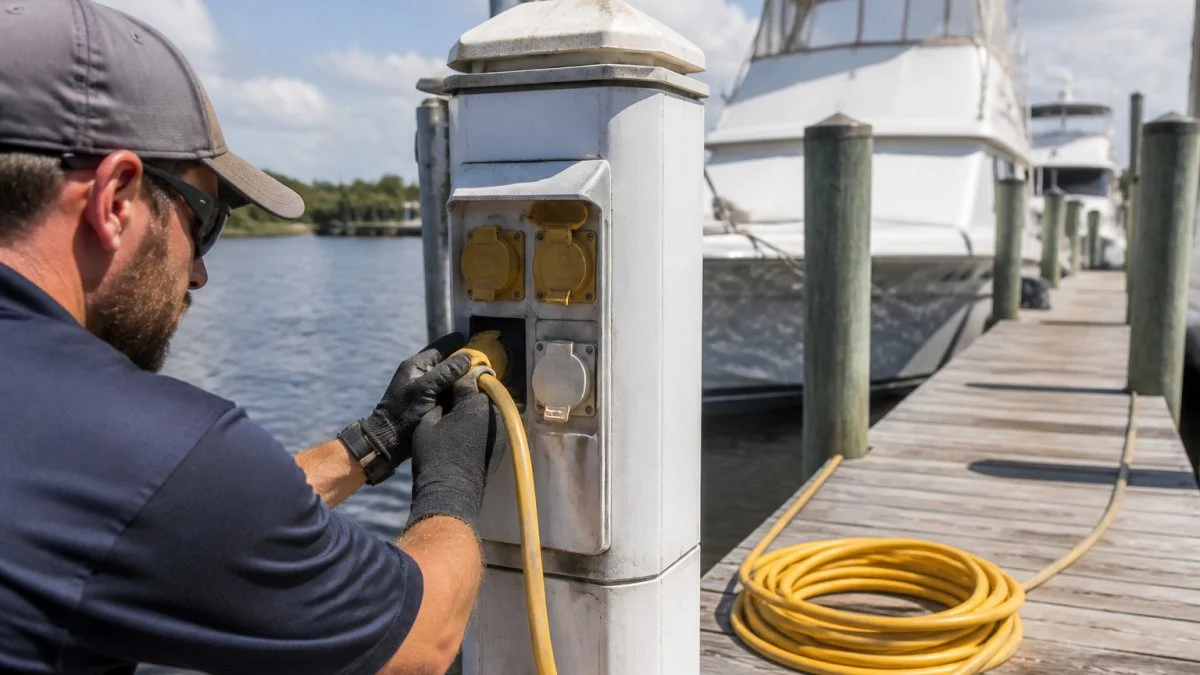
Table of Contents
- Marine Electrical Code Requirements for Docks: Overview
- NEC Article 555 and Dock Electrical Installations
- Dock GFCI Protection Requirements and Ground-Fault Safety
- Marina Ground-Fault Protection Standards
- Dock Electrical Wiring Requirements and Equipment Standards
- Dock Electrical Safety Inspection and Compliance Checklist
- Electrical Hazards in Water: Shock and Electrocution Prevention
- Working with a Licensed Electrician for Dock Installations
- Frequently Asked Questions
Last Updated: October 5, 2026
Marine Electrical Code Requirements for Docks: Overview
Marine electrical code dock installations must follow the National Electrical Code and specialized standards that prevent electrocution and fire hazards in water environments. At Accurate Electric LLC, we’ve worked with Tampa Bay waterfront owners who need compliant dock power systems that withstand saltwater corrosion.
The primary framework is the National Electrical Code, specifically Article 555, which sets minimum safety requirements for marinas and docking facilities. Water conducts electricity, so every connection, receptacle, and grounding system demands precision.
Understanding marine electrical code requirements protects owners from liability, ensures inspector approval, and prevents shock and electrocution. Whether upgrading or installing new shore power, the rules are stricter than residential standards.
NEC Article 555 and Dock Electrical Installations
Article 555 of the National Electrical Code (NEC) is the primary standard for marinas, boatyards, and docking facilities where boats connect to shore power. It addresses wiring methods, receptacle ratings, ground-fault protection, grounding and bonding, and physical protection of equipment exposed to water, spray, and corrosive air.
Why “Which Edition Applies?” Is the First Question to Answer
The NEC is revised every three years by the National Fire Protection Association (NFPA), with recent editions including 2017, 2020, and 2023. Article 555 has been reorganized and expanded across these cycles, so the same dock can be evaluated differently depending on the adopted edition.
There is no single national effective date. Adoption happens state by state and often city by city or county by county.
Before any design or upgrade work, confirm three things in writing: (1) the exact NEC edition your authority having jurisdiction (AHJ) has adopted, (2) any local amendments layered on top, and (3) the permit and inspection process for marine electrical work. Your AHJ, typically the local building or electrical department, is the final word, not the model code alone.
How to Verify the Edition and Amendments That Apply to Your Dock
- Identify your AHJ. Usually the city or county building/electrical department; some waterfront and commercial sites also involve a state or federal authority.
- Ask for the adopted code edition in writing. Request the specific NEC edition and year being enforced.
- Request the amendment list. Many jurisdictions publish local amendments separately; don’t assume the model code is the whole story.
- Confirm the permit path. Ask whether a permit is required, what inspections are triggered, and whether a licensed electrician must pull it.
- Document the answers. Keep edition, amendments, and permit notes with your project records for future maintenance and resale.
What Article 555 Addresses in Practice
Regardless of edition, Article 555 and related NEC articles address the same core safety concerns for docks:
- Ground-fault protection for receptacles and feeder circuits serving shore power.
- Grounding and bonding of metal parts, equipment frames, and the grounding electrode system to limit voltage differences.
- Receptacle and equipment ratings suitable for wet and corrosive locations.
Because details shift between editions, design and install to the edition your AHJ enforces, and treat the newest published edition as best-practice reference, not an automatic legal requirement.
Local Amendments You Commonly See in Coastal Areas
While amendments vary widely, coastal jurisdictions commonly add language on:
- Corrosion resistance for hardware, enclosures, and conductors in salt air.
- Enhanced bonding for metal dock structures and pilings.
- Additional grounding for equipment near the waterline.
These amendments are not universal, so never assume a neighboring jurisdiction’s rules apply. Confirm the adopted edition and amendments with your AHJ before work begins.
Referencing the “latest” NEC in a design without confirming local adoption can lead to failed inspections or unnecessary cost. Always build to the edition your AHJ enforces.
Where to Find the Authoritative Text
The full NEC text, including Article 555, is published by the NFPA, and many jurisdictions publish their adopted code and amendments online.
NFPA National Electrical Code information
A licensed electrician who regularly works in your jurisdiction will already know the local edition and amendments, which is a strong reason to involve one early in planning rather than after equipment is purchased.
Dock GFCI Protection Requirements and Ground-Fault Safety
Ground-fault circuit interrupters are the primary defense against electrical shock in dock environments, detecting current imbalances and disconnecting power in milliseconds, fast enough to prevent lethal injury.
All receptacles within 6 feet of the water’s edge must be GFCI-protected, whether they serve permanent dock equipment, boat charging systems, or temporary power needs. The 6-foot boundary is measured horizontally from the water line, not vertically from the dock surface.
GFCI vs. GFEP: Key Differences and Applications
Ground-Fault Equipment Protection (GFEP) protects equipment by monitoring the energized and grounded conductors, disconnecting power if a fault develops within the equipment or its wiring.
The distinction matters: GFCI outlets and breakers protect people from shock, while GFEP safeguards shore-power pedestals and permanent wiring from fault damage.
The trip threshold for dock GFCI devices is 30 milliamps, sensitive enough to detect dangerous ground faults but not so sensitive that normal leakage current causes nuisance trips.
Marina Ground-Fault Protection Standards
Marina ground-fault protection extends beyond individual receptacles to the entire electrical system serving the docking facility, including the main feeder circuit, shore-power pedestal, and all branch circuits supplying receptacles.
Bonding connects all conductive parts, metal water pipes, structural components, equipment frames, and the grounding electrode, into a unified system.
Grounding provides the system’s reference point.
Together, bonding and grounding let GFCI and GFEP devices function as intended. Without them, fault detection becomes unreliable and shock hazards increase significantly.
Dock Electrical Wiring Requirements and Equipment Standards
Dock wiring must tolerate wet environments, salt spray, and temperature swings; standard residential insulation degrades rapidly in marine settings. Dock installations require marine-grade cable, corrosion-resistant hardware, and enclosures rated for wet locations.
Receptacle Types, Voltage, and Amperage Specifications
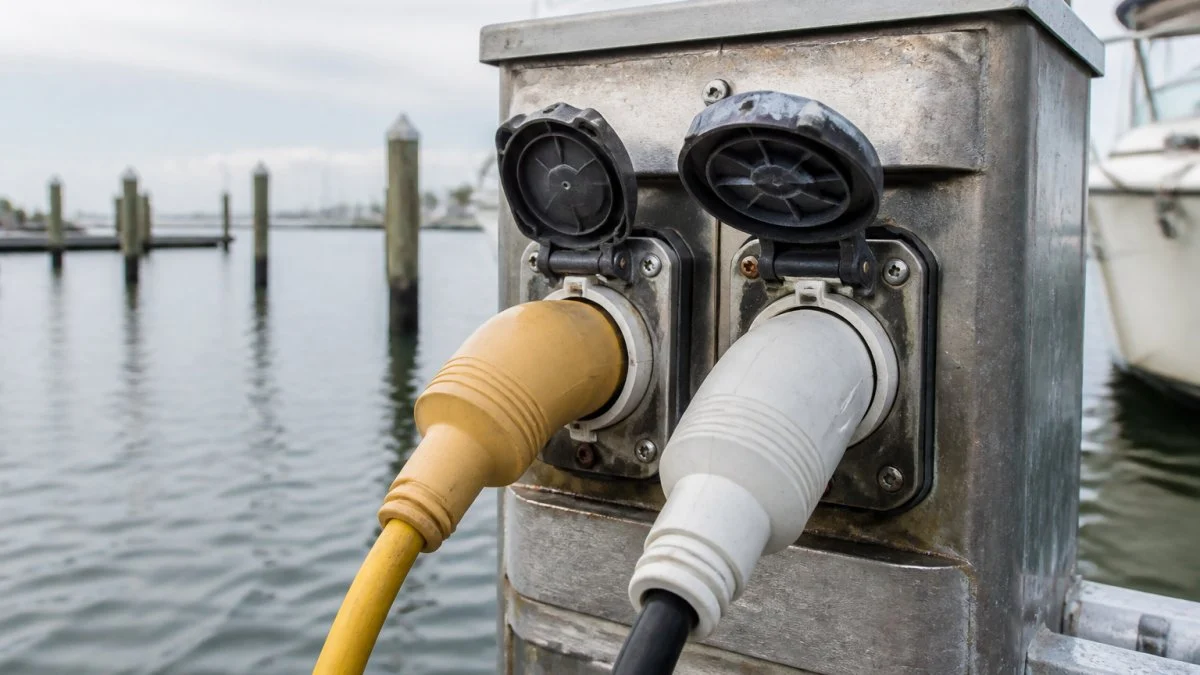
Dock receptacles come in standardized configurations based on boat size and power demand.
Both must be rated for wet locations with weatherproof covers and drain holes, and built from corrosion-resistant materials such as marine-grade stainless steel or powder-coated steel with protective sealing.
Incoming service at the dock pedestal is typically 120/240 volts single-phase for residential installations; commercial marinas may use three-phase 208V or 277/480V systems, stepped down by the property’s transformer or service entrance.
Shore-Power Connections and Boat Electrical Systems
Shore-power connections link the dock receptacle to the boat’s electrical system through a heavy-gauge marine cable and marine-grade plug connector; the boat’s onboard charger or converter then distributes power throughout the vessel.
The cable must be rated for marine use, with insulation resisting saltwater, UV exposure, and mechanical damage.
The boat has its own overcurrent protection, grounding, and bonding, but the shore-power connection must also meet dock-side requirements.
Marine-Grade Enclosures and Corrosive Environment Protection
All dock electrical equipment must be housed in enclosures rated for wet locations.
Material matters: stainless steel resists saltwater corrosion better than powder-coated steel, and aluminum should be avoided in saltwater due to galvanic corrosion when paired with steel hardware.
Mount the pedestal on a concrete pad above the highest anticipated water level with drainage to prevent pooling, and use schedule 40 PVC or stainless steel conduit.
Dock Electrical Safety Inspection and Compliance Checklist
A dock electrical system should be inspected before energizing, after any major repair or storm, and on a recurring schedule. The checklist below covers assessment, installation verification, testing, documentation, and inspection.
Step 1, Pre-Work Assessment
- Confirm the adopted NEC edition and local amendments with your AHJ.
- Identify service size, voltage, and phase at the dock pedestal.
- Inventory every receptacle, disconnect, and permanently wired equipment.
Step 2, Installation Verification
- Verify enclosures are rated for wet locations (commonly NEMA 3R or 4X).
- Confirm conductors and terminations suit wet, corrosive environments.
- Check grounding and bonding conductors are continuous and correctly terminated.
Step 3, Testing and Commissioning
- Verify voltage at each receptacle under no load and under load.
- Test every GFCI and GFEP device with its built-in test function; confirm it trips and resets.
- Check bonding continuity between metal parts and the grounding system.
Testing is not a one-time event. Ground-fault devices can fail silently, so functional testing on a recurring schedule is the only way to know protection is actually present.
Step 4, Documentation
Keep a dock electrical file with:
- The adopted code edition and amendments confirmed with your AHJ.
- Permit and inspection records.
- Equipment cut sheets and ratings for receptacles, enclosures, and protective devices.
This supports insurance claims, resale, and future inspections, and speeds recurring maintenance.
Step 5, Inspection and Sign-Off
A qualified inspector verifies that components meet the adopted code, grounding and bonding are properly installed, ground-fault devices function, and receptacles are correctly located and protected. Inspection is often required before utility connection and always valuable for liability protection. Ask for deficiencies in writing so they can be corrected and re-verified.
Ongoing Maintenance Schedule
- Monthly: Operate the test button on GFEP devices where the manufacturer or AHJ calls for it.
- Annually (minimum): Test GFCI receptacles and document results.
- Quarterly in saltwater or high-exposure settings: Visually inspect for corrosion, water intrusion, and physical damage.
In corrosive environments, inspection intervals often need to be shorter than the minimum. Let observed corrosion rates, not the calendar alone, drive the schedule.
What to Do When a Ground-Fault Device Trips
A trip is a signal, not a nuisance. Follow this sequence:
- Do not repeatedly reset. Repeated resets can mask a real fault.
- Disconnect loads. Unplug boats and equipment from the affected circuit.
- Reset once. If it holds with no load, the fault may be in connected equipment.
- Reconnect loads one at a time. Identify which load causes the trip.
- If it trips with no load, stop using the circuit and contact a licensed electrician.
- Document the event. Note the date, conditions, and outcome.
If a device trips repeatedly, diagnose it, never bypass or remove it. Doing so creates a serious shock and fire hazard and may violate the adopted code.
Working With a Licensed Electrician
Dock electrical work calls for marine experience, code knowledge, and familiarity with local amendments. A licensed electrician can confirm the adopted edition, design to it, install marine-rated equipment, perform commissioning tests, and provide documentation for inspection and insurance.
Electrical Hazards in Water: Shock and Electrocution Prevention
Water conducts electricity, making dock environments inherently hazardous. As little as 50 milliamps can cause cardiac arrest; 100-200 milliamps is typically fatal.
The hazard exists whether current flows through someone touching an energized conductor or through someone in the water if a fault energizes it.
The secondary hazard is fire: electrical faults at docks can ignite fuel vapors from boats or stored gasoline.
Working with a Licensed Electrician for Dock Installations
Dock electrical installations demand expertise in marine environments, code compliance, and water-adjacent equipment.
At Accurate Electric LLC, our licensed electricians bring over 31 years of combined experience to dock and marine electrical projects.
When selecting an electrician, verify Florida licensing, ask about marine installation experience, request references from other waterfront properties, and confirm they stay current with code updates.
Dock electrical safety depends on implementing NEC Article 555, local amendments, and marine-environment standards.
Frequently Asked Questions
What is NEC Article 555 and why does it apply to my dock?
NEC Article 555 governs electrical installations at marinas and docking facilities. It establishes ground-fault protection, receptacle requirements, grounding and bonding standards, and wiring specifications for any dock or marina where boats connect to shore power. If your property has a dock with electrical outlets for boats, Article 555 compliance is mandatory. Your local jurisdiction may adopt the current NEC edition or a previous one, so confirm which edition your authority has adopted before installation or inspection.
What is the difference between GFCI and GFEP protection on a dock?
GFCI (ground-fault circuit interrupter) devices protect individuals from electrical shock. GFEP (ground-fault equipment protection) protects equipment from damage. Both are essential: GFCI guards against electrocution hazards in wet environments, while GFEP prevents fires and equipment failures. A licensed electrician can ensure both protections are properly installed and tested.
What receptacle types and amperage ratings are required for dock outlets?
Dock receptacles must be marine-grade, tamper-resistant, and suitable for wet locations. Standard configurations include 30-amp 125-volt outlets for smaller boats and 50-amp 125/250-volt outlets for larger vessels. All receptacles must be grounded and bonded according to NEC Article 555. Receptacles must also have ground-fault protection and be housed in corrosion-resistant enclosures. The specific amperage and voltage depend on the boats served and local electrical code amendments. A licensed electrician can assess your dock’s needs and select compliant equipment.
How often should dock electrical systems be inspected and tested?
Initial inspection and testing occur during installation and commissioning to verify GFCI and GFEP operation, grounding continuity, and bonding integrity. Ongoing maintenance typically involves annual visual inspections for corrosion, damage, or loose connections, and periodic testing of ground-fault devices. After severe weather or suspected electrical faults, immediate inspection is necessary. A licensed electrician can perform these inspections and tests to confirm continued compliance and safety. Maintenance schedules may vary by local authority, so check with your jurisdiction.
What are the main electrical hazards around docks and marinas?
Electric shock and electrocution are the primary hazards when water and energized electrical equipment meet. Faulty wiring, inadequate ground-fault protection, corroded equipment, and improper bonding increase risk. Saltwater and freshwater environments accelerate corrosion of unprotected wiring and enclosures. Damaged shore-power cables or wet boat electrical systems can energize water, creating a fatal hazard. Ground-fault protection devices, marine-grade enclosures, proper grounding and bonding, regular inspection, and maintenance all reduce these risks. Any suspected electrical fault in a dock or marina should be addressed immediately by a licensed electrician.
Why do I need a licensed electrician for dock electrical work?
Dock electrical installations involve complex NEC requirements, water safety hazards, and corrosive marine environments. A licensed electrician understands Article 555 standards, local code amendments, proper grounding and bonding techniques, and GFCI/GFEP protection. They perform correct installation, testing, and commissioning to prevent shock, fire, and equipment failure. Licensed electricians carry insurance and guarantee code compliance, protecting you from liability and ensuring your dock meets inspection standards. For any dock electrical installation or repair, hiring a licensed and insured professional is essential for safety and legal compliance.
What happens if my dock electrical system fails inspection?
Inspection failures typically identify missing GFCI or GFEP protection, improper grounding or bonding, corroded equipment, non-compliant receptacles, or damaged wiring. Your authority having jurisdiction (AHJ) will issue a list of corrections required. A licensed electrician can address these issues by upgrading protection devices, replacing corroded enclosures, installing proper bonding, or rewiring sections as needed. Once corrections are complete, a re-inspection confirms compliance. Delaying repairs leaves your dock unsafe and may prevent boat owners from legally connecting shore power. Prompt remediation with a licensed electrician resolves failures quickly.












continue reading
Related Posts

Learn how to hire a qualified electrician for EV charger installation. Find credentials, costs, permits, and safety standards you need to know.
Licensed electrician tampa bay: Find licensed electricians in Tampa Bay with verified credentials, emergency services, and transparent pricing.
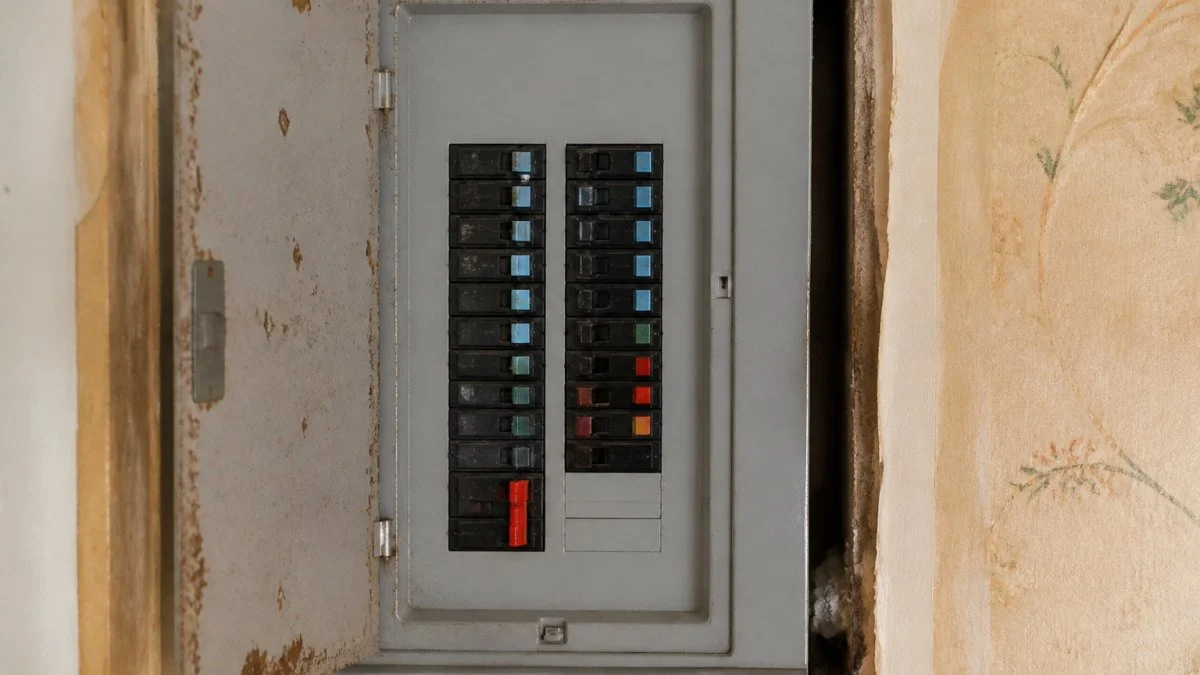
Federal pacific panels dangerous: Federal Pacific panels pose serious fire and safety risks. Learn why FPE Stab-Lok breakers fail, how to identify them.
Get Social