


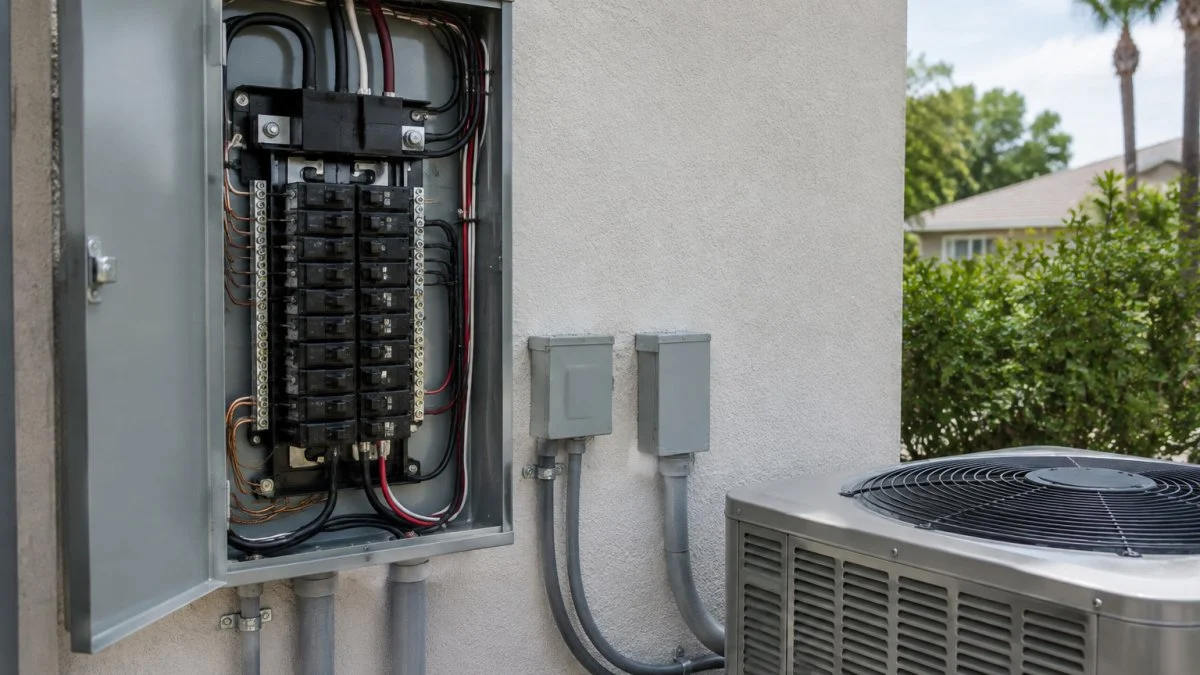
Last Updated: November 22, 2026
Quick Summary
A 100 amp panel can support a heat pump in many homes, but it depends on the home’s total electrical load, not just the panel rating. Existing loads like an electric range, clothes dryer, water heater, and central air conditioning decide whether the service has room. A load calculation settles the question.
- The service rating of 100 amps is the total capacity coming into the home.
- The heat pump needs its own dedicated circuit with the right breaker and wire size.
- A load calculation, not a guess, tells you whether the upgrade is needed.
- Empty breaker spaces do not prove the service can carry an added heat pump load.
Table of Contents
- Can a 100 Amp Panel Support a Heat Pump?
- Panel Rating, Service Capacity, and Breaker Spaces Explained
- How to Calculate Household Electrical Load Using the NEC Optional Method
- Heat Pump Breaker Size and Wire Requirements on a 100 Amp Service
- Can a Heat Pump and EV Charger Share a 100 Amp Service?
- Heat Pump Panel Upgrade Cost and When the Upgrade Makes Sense
- Scheduling a Load Assessment for Your Home
- Frequently Asked Questions
Can a 100 Amp Panel Support a Heat Pump?
A 100 amp panel can support a heat pump in many homes, but it depends on what else runs on that service. Whether the panel has room for the heat pump is a separate question from whether the home’s total electrical load fits within 100 amps.
Homeowners often ask this question before a heat pump project. The honest answer is conditional. A 100 amp service may handle a heat pump, but existing loads like an electric range, clothes dryer, water heater, and central air conditioning decide the outcome.
Here is what matters most:
- The service rating (100 amps) is the total capacity coming into the home.
- The heat pump needs its own dedicated circuit with the right breaker and wire size.
- A load calculation, not a guess, tells you whether the upgrade is needed.
Many homeowners find that a licensed electrician can answer the question after a short load review. NFPA 70 National Electrical Code overview
Panel Rating, Service Capacity, and Breaker Spaces Explained
Panel rating, service capacity, and breaker spaces are three different things, and conflating them is the most common reason homeowners get the wrong answer about a heat pump. A panel can have empty breaker spaces and still lack the capacity for a new heat pump. The reverse is also possible. Understanding why requires looking at what each term actually measures.
- Panel rating: The maximum current the panel enclosure and busbar are listed to carry, such as 100 amps. It is a hardware limit stamped on the panel label, not a measure of what the utility delivers.
- Service capacity: The amount of power the utility actually delivers to the home, which the main breaker and the service entrance conductors limit. A 100 amp panel with a 100 amp main breaker on a 100 amp service drop is a true 100 amp service. A 100 amp panel fed by a 200 amp service is not.
- Breaker spaces: The physical slots where new circuit breakers fit. An empty slot proves only that a breaker can be installed, not that the service can carry the added load.
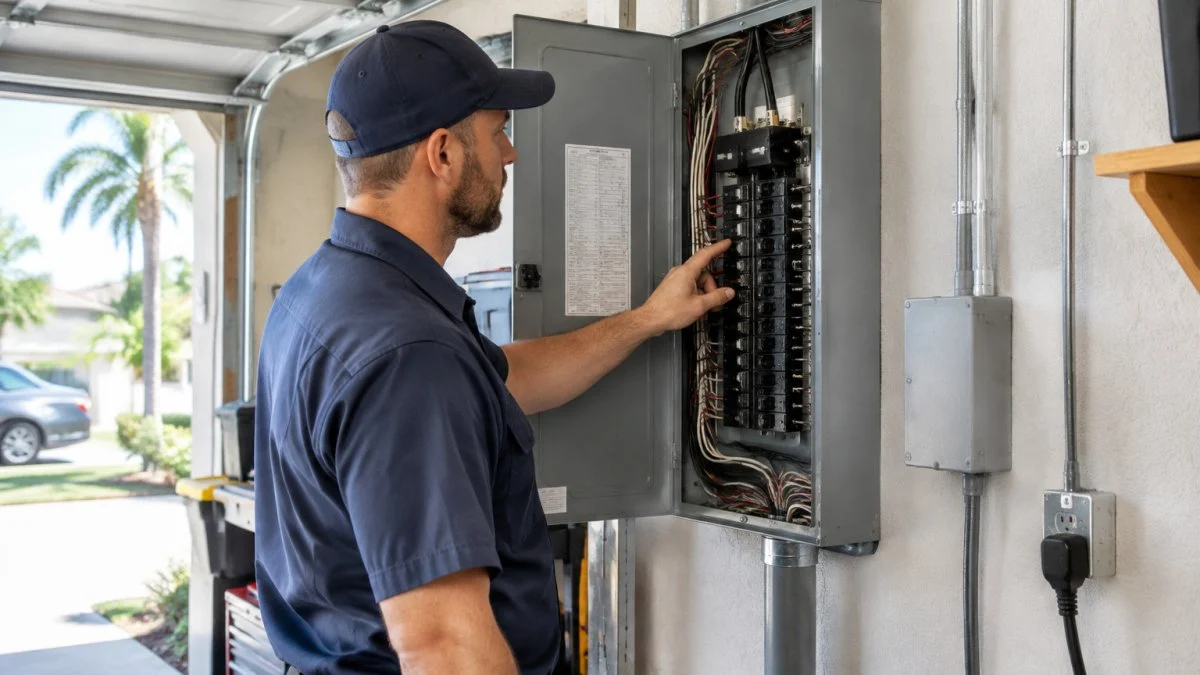
A licensed electrician in work clothes inspects a residential main electrical panel with its cover open in a Florida garage, checking breaker spaces and labeling.
The mechanism that trips people up is the difference between a physical slot and an electrical budget. A 100 amp panel with a 100 amp main breaker has a total electrical budget of 100 amps.
A second mechanism is the difference between the panel and the service.
A third mechanism is the main breaker. Some panels are rated for 100 amps but have a 60 amp main breaker, or a 125 amp panel with a 100 amp main. The main breaker, not the panel label, sets the practical ceiling for the service.
Watch out: A panel with open breaker spaces and a 100 amp main breaker can still fail a load calculation once the heat pump and existing appliances are added. Empty slots are not evidence of available capacity.
How to Calculate Household Electrical Load Using the NEC Optional Method
A load calculation is the only defensible way to answer whether a 100 amp service can carry a heat pump. The National Electrical Code (NEC) Article 220.82 optional method is the standard approach for a single-family dwelling, and it is the method most electricians use for a heat pump feasibility review. NFPA 70 National Electrical Code overview
The optional method works in two layers. First you total the general load, then you add the largest motor or heating/cooling load, then you apply the demand factors the code permits.
- General lighting and receptacles: 3 volt-amperes (VA) per square foot of living area.
- Small appliance and laundry circuits: 1,500 VA for each 20-amp small appliance branch circuit and 1,500 VA for the laundry circuit.
- Fixed appliances: nameplate VA for the range, dryer, water heater, dishwasher, disposal, and similar loads. The code lets you use the nameplate rating rather than a guess.
- Apply the 10,000 VA threshold: take the first 10,000 VA of the general load at 100 percent, and the remainder at 40 percent.
- Add the larger of heating or cooling: use the heat pump’s nameplate VA (or the MCA times 240 volts) for cooling, and the same for heating, but never both at once unless the equipment can run both simultaneously.
- Add 25 percent of the largest motor: the heat pump compressor is typically the largest motor, and the code requires the 25 percent adder.
- Convert to amps: divide total VA by 240 volts to compare against the 100 amp service rating.
Watch out: The optional method is not a free pass. It assumes the dwelling has a single feeder and that the load is reasonably diversified. A home with an electric tankless water heater, a hot tub, or a Level 2 EV charger can still exceed 100 amps even after demand factors.
A Worked Load Calculation Example
Here is a transparent example for a 2,000 square foot home with an electric range, an electric clothes dryer, an electric water heater, and a 3-ton heat pump. The numbers below are illustrative and must be replaced with the actual nameplate data for your equipment.
- General lighting: 2,000 sq ft × 3 VA = 6,000 VA
- Small appliance circuits (2) + laundry: 3 × 1,500 VA = 4,500 VA
- Electric range: 8,000 VA nameplate
- Electric dryer: 5,500 VA nameplate
- Electric water heater: 4,500 VA nameplate
- Heat pump (cooling): 3-ton unit at 240 V, MCA 20 A → 4,800 VA
- Largest motor adder: 25% of 4,800 VA = 1,200 VA
Now apply the optional method demand factors. The general load (lighting + small appliance + laundry + range + dryer + water heater) totals 28,500 VA. The first 10,000 VA counts at 100 percent, and the remaining 18,500 VA counts at 40 percent (7,400 VA). That gives 17,400 VA of general load.
That result is a warning, not a green light. A 97.5 amp calculated load on a 100 amp service leaves almost no margin for a future EV charger, a hot tub, or a larger heat pump with auxiliary resistance heat.
Watch out: Adding every appliance at full nameplate rating without the demand factors would have produced a much higher number and an unnecessary upgrade recommendation. The code’s demand factors exist precisely because not every load runs at once.
Heat Pump Breaker Size and Wire Requirements on a 100 Amp Service
Every heat pump needs a dedicated circuit. The breaker and wire size come from the equipment’s nameplate, not from a general rule.
Look for two values on the nameplate:
- Minimum circuit ampacity (MCA): The smallest wire capacity the circuit can use.
- Maximum overcurrent protection (MOP): The largest breaker allowed on the circuit.
Wire must carry at least the MCA, and the breaker cannot exceed the MOP. Sizing that is too small causes nuisance trips. Sizing that is too large creates a fire risk.
Most residential heat pumps run on 240 volts. Confirm the voltage on the nameplate before buying wire or breakers.
Heat pump circuit sizing comes from two values on the equipment nameplate, as the article explains:
| Nameplate value | What it sets | Rule |
|---|---|---|
| Minimum circuit ampacity (MCA) | Smallest wire capacity | Wire must carry at least the MCA |
| Maximum overcurrent protection (MOP) | Largest breaker allowed | Breaker cannot exceed the MOP |
| Voltage | Circuit voltage | Most residential heat pumps run on 240 volts |
Can a Heat Pump and EV Charger Share a 100 Amp Service?
Sometimes, but the two loads together often push a 100 amp service to its limit. An EV charger is a large continuous load, and continuous loads are counted at 125 percent under the code.
This is where many homeowners get surprised. A heat pump plus a Level 2 EV charger can add up quickly, even when each one alone seems to fit. A load calculation shows whether both can share the service or whether a load management device or a service upgrade makes more sense.
Readers who have seen their breaker trip while charging a car should know that the cause can be the charger’s circuit size, the shared load, or a loose connection. For a deeper look at the causes, read our guide on EV charger tripping breaker causes. Our team also handles EV charger installation for homeowners planning both projects.
Heat Pump Panel Upgrade Cost and When the Upgrade Makes Sense
An upgrade makes sense when the load calculation shows the existing service cannot carry the planned equipment with a reasonable margin. Pricing depends on the specific project, so contact Accurate Electric LLC through our website for a current quote.
Signs the upgrade is likely needed include a panel that is already full, a calculated load close to or above 100 amps, or a panel brand with known safety concerns. Our page on signs your electrical panel needs an upgrade explains the warning signs in more detail.
Once the decision is made, a panel change replaces an outdated panel with a code-compliant one sized for the new load.
Scheduling a Load Assessment for Your Home
A load assessment is the fastest way to get a real answer. A licensed electrician reviews your panel, your existing loads, and the heat pump’s nameplate data, then gives you a clear recommendation.
Here is what to bring or have ready:
- Recent photos of your main panel and its label
- A list of major appliances and their ratings
- The heat pump model number, if you have chosen one
If an upgrade is needed, our electrical panel and service upgrade team can plan the work around your project timeline. Accurate Electric LLC offers load review and installation for residential projects. Call us to schedule a load assessment and get a clear answer before you commit to equipment.
Frequently Asked Questions
Is 100-amp service enough for a heat pump?
It can be, but it depends on what else the home draws. A 100-amp service provides roughly 24,000 watts of capacity at 240 volts. A heat pump’s nameplate minimum circuit ampacity and maximum overcurrent protection determine the dedicated circuit size, and the NEC load calculation determines whether the total load fits within the service. Homes with electric ranges, electric water heaters, or a clothes dryer often need a load calculation before adding a heat pump. A licensed electrician can run that calculation with your actual equipment data.
Does a heat pump require a panel upgrade?
Not always. Many heat pumps install on existing 100-amp panels when the load calculation shows enough available capacity and there are open breaker spaces for a dedicated 240-volt circuit. A panel upgrade is typically needed when the calculated load exceeds the service rating, when the panel lacks space for the breaker, or when the panel is an older model with known safety concerns. The only way to confirm is a load calculation based on your specific heat pump and existing loads.
Can a 100-amp panel run a heat pump and an EV charger?
Sometimes, but usually only with load management. An EV charger is a continuous load and typically requires a 40 to 50 amp dedicated circuit. Adding it alongside a heat pump on a 100-amp service can exceed available capacity unless the load calculation supports both, or a load management device limits the charger’s draw when other major appliances run. Each combination should be checked against the NEC optional method calculation before installation.
How do you calculate whether a 100-amp panel has capacity for a heat pump?
Start with the service rating, then calculate the household load using the NEC optional method, which uses the nameplate ratings of the largest loads and applies demand factors. Add the heat pump’s nameplate load as a new load and compare the total against 80 percent of the service rating for continuous loads. Confirm the breaker spaces and the heat pump’s minimum circuit ampacity and maximum overcurrent protection. Have a licensed electrician verify the calculation, because inaccurate inputs produce inaccurate results.













continue reading
Related Posts

Lightning strikes nearby can fry appliances without ever hitting your home.

Learn how to test voltage drop at home with a digital multimeter. Follow safe, step-by-step checks for outlets, long wire runs, and flickering lights.

Learn what a home EV charger install really costs, from panel upgrades to wiring distance, and how to compare quotes before you commit.
Get Social