


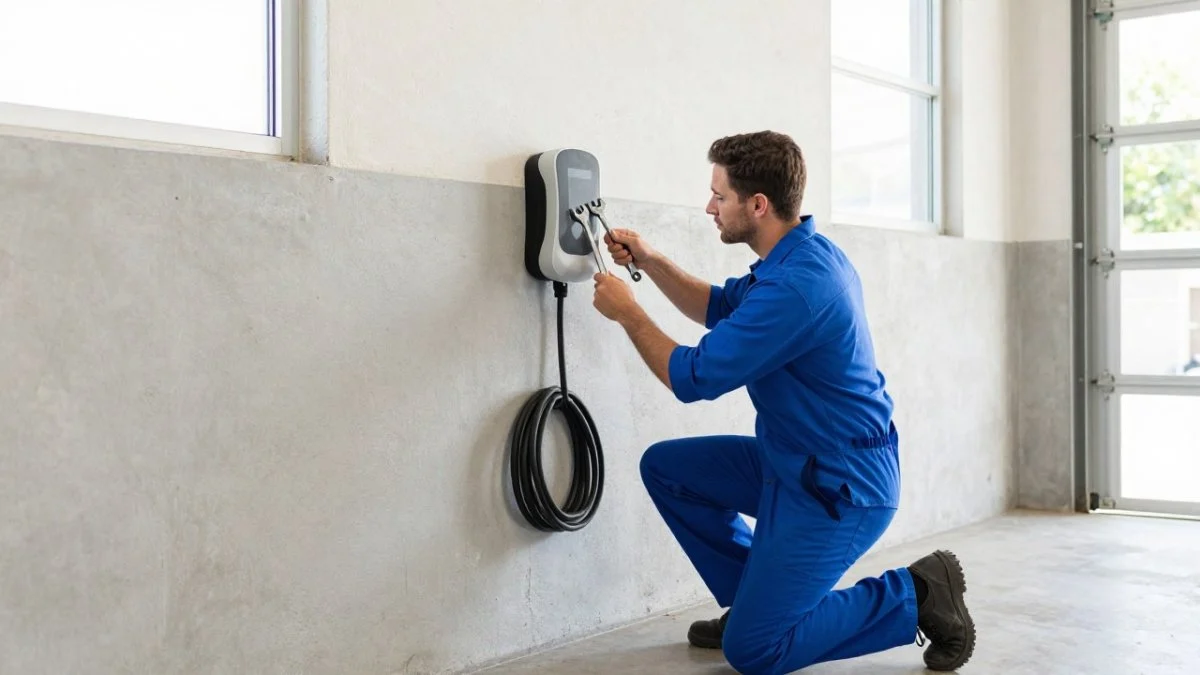
Last Updated: November 24, 2026
Quick Summary
A home EV charger installation cost depends on the charger level, the distance from your electrical panel, and whether your panel needs an upgrade. Because pricing depends on your specific home, a written quote for your project is the most reliable figure.
- Level 1 charging uses a standard 120-volt outlet and adds a modest amount of range per hour.
- Level 2 charging runs on a 240-volt circuit and charges considerably faster than Level 1.
- Ask every bidder to list exactly what is included before comparing quotes.
- A quote that looks low often leaves out the panel check or the permit.
- Check your main breaker rating and open breaker slots before requesting quotes.
Table of Contents
- How Much Does It Cost to Install a Home EV Charger?
- Level 1 vs. Level 2 Charger Costs at Home
- Electrician Labor Rates and What Drives Installation Labor
- Electrical Panel Upgrades and Hidden Installation Costs
- Home Charging vs. Public Charging Stations: Running Costs
- How to Assess Your Electrical Capacity and Compare Quotes
- Booking Your Home Charger Installation Assessment
- Frequently Asked Questions
How Much Does It Cost to Install a Home EV Charger?
The cost of installing a home EV charger depends on the charger type, the distance to your electrical panel, and whether your panel needs an upgrade. Accurate Electric LLC has worked on residential charger installs across the Tampa Bay area for more than 31 years. Pricing depends on the specifics of your home, so a written quote for your project is the most reliable figure. For current pricing on your project, contact Accurate Electric LLC directly.
Several factors affect the total cost of a charger installation, including the charger hardware, the electrician’s labor, and any work needed to bring power to the charger location. A shorter cable run from an existing panel generally requires less work than one that crosses a finished basement or runs out to a detached garage.
A common mistake is comparing quotes that cover different scopes. One electrician may include a new dedicated circuit, permit fees, and inspection. Another may quote only the outlet. Ask every bidder to list exactly what is included before you compare numbers.
Level 1 vs. Level 2 Charger Costs at Home
The charger level you choose drives both the hardware price and the installation scope, so decide this before you request bids.
Level 1: 120-volt charging
Level 1 uses a standard 120-volt household outlet and adds a modest amount of range per hour, which is enough for many commuters who can plug in overnight (Alternative Fuels Data Center: Electric Vehicle Charging Stations). Some owners use an existing outlet, while some electricians recommend a dedicated 20-amp circuit so the charger does not share a circuit with a garage door opener or freezer. For practical ways to keep the electricity bill down, see how to reduce EV home charging costs.
The trade-off is speed: a full charge on a 60 kWh battery can take more than 24 hours.
Level 2: 240-volt charging
Level 2 runs on a 240-volt circuit and charges considerably faster than Level 1. Installation requires a dedicated double-pole breaker, appropriate wire, and either a hardwired unit or a 240-volt outlet.
Common circuit configurations:
- 40-amp circuit: 32-amp continuous charging, 8-gauge copper wire, about 7.7 kW.
- 50-amp circuit: 40-amp continuous charging, 6-gauge copper wire, about 9.6 kW.
- 60-amp circuit: 48-amp continuous charging, 6-gauge copper wire, about 11.5 kW; requires a hardwired unit because standard 14-50 outlets are not rated for 48 amps continuous.
Hardwired versus 240-volt outlet:
| Option | Typical parts cost | Trade-off |
|---|---|---|
| Hardwired | $0 for outlet; disconnect may be required | Cleaner install, supports 48-amp charging, but the unit is not portable |
| NEMA 14-50 outlet | $50-$150 in parts | Allows a portable charger and easier replacement, but capped at 40-amp continuous charging |
Hardware is priced separately from installation, and pricing depends on the unit and its features. Load-management hardware can matter on older panels because it can let a charger share capacity with existing appliances instead of forcing a service upgrade.
Watch out: a charger’s amperage should match the circuit the electrician confirms your panel can support.
Electrician Labor Rates and What Drives Installation Labor
Labor is often a significant expense on a Level 2 install. Electrician rates vary by company, experience, and job complexity, so getting several written estimates is a sensible step. Rates alone do not tell you the total cost. An electrician who charges more per hour but finishes in four hours may cost less than one who charges less and needs a full day.
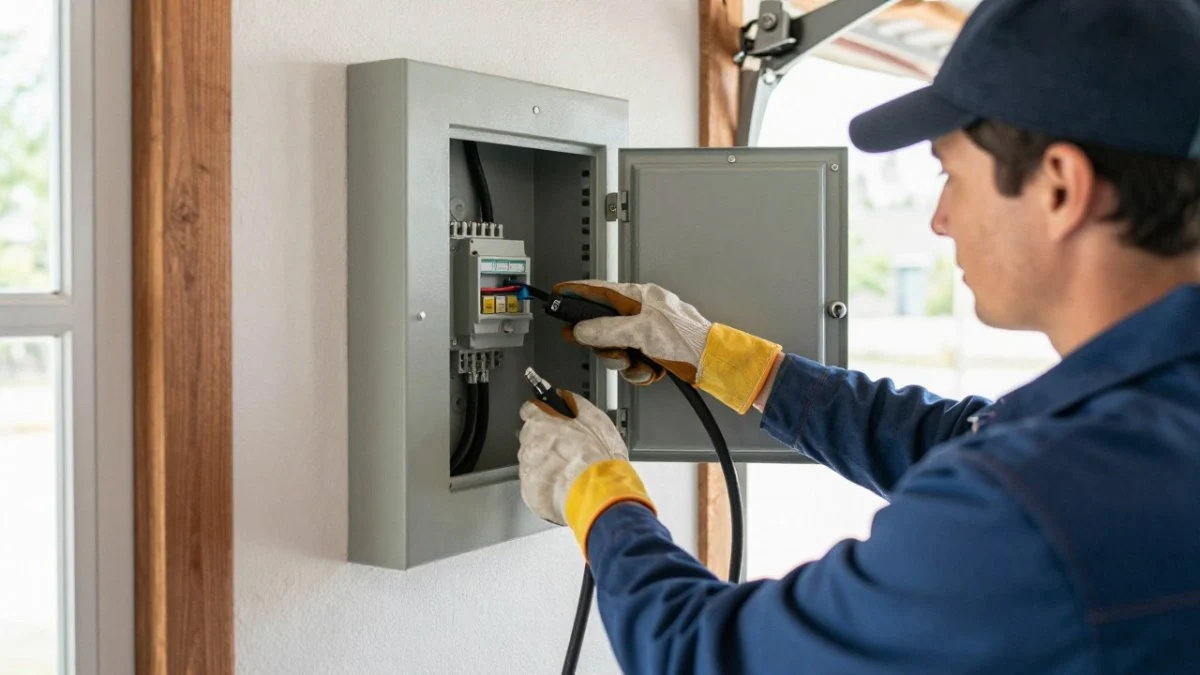
Several factors drive labor time:
- Distance from the panel: Longer wire runs take more time and more material.
- Mounting location: Garage walls are simpler than exterior walls with conduit runs.
- Access: Finished walls, attics, and crawl spaces add time for routing wire.
- Panel condition: An older panel with no open breaker slots adds work.
Watch out: a quote that looks low often leaves out the panel check or the permit. Ask whether the price includes the load calculation, the permit, and the final inspection.
Electrical Panel Upgrades and Hidden Installation Costs
Many homeowners find that their electrical panel, rather than the charger itself, determines what work is needed. A panel with limited capacity may need an upgrade before a new charger circuit can be added safely. Homes built before the 1990s may have older panels that a licensed electrician should evaluate. Accurate Electric LLC can assess your panel and advise whether an upgrade is needed before you commit to a charger.
Other hidden costs include trenching for underground wire, patching drywall after routing, and upgrading the meter base if the utility requires it. Ask your electrician to walk the path with you before the job starts.
Permits, Inspections, and Timelines
Most jurisdictions require a permit for new circuits, and the permit process typically adds a few days to a few weeks before work can begin. A licensed electrician usually pulls the permit as part of the job. After installation, an inspector confirms the work meets the National Electrical Code and local amendments. Permit fees vary by county and city, so confirm the amount with your local building department.
Project duration depends on the scope of the work, and a panel upgrade or longer cable run typically takes more time. Your power may be off for part of that time, and the electrician should tell you the expected outage window in advance.
Home Charging vs. Public Charging Stations: Running Costs
Charging at home is almost always cheaper per mile than paying for public fast charging, but the actual savings depend on your local electricity rate and the time-of-use plan your utility offers. Many utilities offer lower overnight rates for EV owners, which can significantly reduce the cost of home charging.
Public charging stations may price by the kilowatt-hour or by the minute, and pricing varies by network. Your savings grow if you can charge at home most nights rather than relying on public stations for daily driving. Compare your utility’s EV rate schedule with the pricing on public networks near you before deciding how much to rely on home charging.
How to Assess Your Electrical Capacity and Compare Quotes
Before you request quotes, gather a few facts about your home so every electrician is bidding on the same scope. This is the step most homeowners skip, and it is the main reason two bids for the “same” job can differ by more than $1,000.
What you can safely check yourself
Do not open the panel cover or remove the deadfront, that is licensed work. You can, however, read the label on the inside of the panel door and note the following:
- Main breaker rating: Look for a number like 100, 150, or 200 amps on the main breaker or the panel label. A 100-amp service is the most common trigger for a panel upgrade when adding a 40- or 50-amp EV circuit.
- Open breaker slots: Count the unused spaces. A charger needs a double-pole breaker, which occupies two slots. If only one slot is open, the electrician may need to rearrange circuits or add a subpanel.
- Panel brand and age: Note the brand and any date stamp, and have a licensed electrician evaluate older panels.
- Major loads: List central air conditioning, electric range, electric water heater, dryer, hot tub, and any shop equipment. These determine whether the existing service has headroom.
- Wiring type at the charger location: Aluminum branch wiring, knob-and-tube, or undersized wire changes the approach and the price.
What the electrician’s load calculation actually does
A load calculation is not a guess. A load calculation is typically performed under the National Electrical Code, which assigns demand factors to general lighting, small-appliance circuits, and large appliances, then adds the new EV load. Adding a charger circuit to a service already carrying several large loads can push the calculation past capacity, which is why a panel upgrade may be recommended.
Ask each bidder to show the calculation in writing, and be cautious of any assessment that cannot be explained.
Itemized sample quotes for common home layouts
Use these line-item patterns to sanity-check the bids you receive. Amounts are typical U.S. ranges and will vary by region, panel condition, and local permit fees.
| Layout | Typical line items | Typical total range |
|---|---|---|
| Attached garage, panel on the same wall, 20-30 ft run | 40-amp double-pole breaker, 8-gauge wire, conduit, hardwired Level 2 unit, permit, inspection | $500-$1,200 plus hardware |
| Attached garage, panel on the opposite side of the house, 60-80 ft run | Longer wire, possible conduit through finished space, drywall patching, permit, inspection | $1,200-$2,000 plus hardware |
| Detached garage, 40-60 ft underground | Trenching or direct-burial cable, conduit, subpanel or disconnect, permit, inspection | $1,800-$3,500 plus hardware |
| Any layout requiring a 200-amp service upgrade | New panel, meter base work, utility coordination, load calculation, permit, inspection | Add $1,500-$4,000 |
Hardware is priced separately, and a hardwired install avoids the cost of a 240-volt outlet and plug, though some jurisdictions require a disconnect.
Quote comparison checklist
Put every bid side by side against the same rows so you are comparing scope, not just the bottom line.
| Item | What to confirm in writing |
|---|---|
| Labor | Hours estimated and whether the rate is flat or hourly |
| Materials | Wire gauge, breaker brand, conduit type, box, disconnect |
| Permit and inspection | Who pulls the permit and who pays the fee |
| Panel work | Load calculation included; upgrade priced separately if needed |
| Charger hardware | Brand, model, amperage, warranty terms |
| Trenching and restoration | Included or excluded; who patches drywall or replaces sod |
| Utility coordination | Who handles any meter base or service upgrade with the utility |
| Workmanship warranty | Length of coverage and what it covers |
| Payment schedule | Deposit amount and when the balance is due |
Watch out: a bid that is noticeably below the others may exclude items such as the permit, the load calculation, or drywall patching. Ask each bidder to initial the checklist so the exclusions are explicit before you sign.
Booking Your Home Charger Installation Assessment
The fastest way to get an accurate number is an on-site assessment. An on-site assessment allows an electrician to review your panel, measure the distance to the charger location, and identify any upgrades before quoting the job. For pricing on your project, contact Accurate Electric LLC through the Electrical Installations page on our website.
Frequently Asked Questions
How much does an electrician charge to install an EV charger at home?
Electrician labor for a standard Level 2 installation depends on how far the charger sits from the electrical panel, whether new conduit is needed, and local labor rates in the Tampa Bay area. Pricing depends on the specific conditions of your home, so a written quote is the most reliable figure. You can request a current estimate directly through our website.
Does installing a Level 2 charger require an electrical panel upgrade?
Not always. A Level 2 charger typically needs a dedicated 240-volt circuit, and whether your existing panel can support it depends on its rated capacity and how much load your home already draws. Older panels may need replacement before a new circuit can be added safely. A load calculation is the reliable way to find out.
Is there a tax credit for installing an EV charger at home?
Federal tax credits for home EV charger installation have changed in recent years and may depend on your income, the charger, and the installation date. Utilities and local programs may also offer rebates. Because eligibility rules change, check current IRS guidance and your utility’s website before purchasing.
How long does it take to install a home EV charger?
A straightforward installation where the panel has capacity and the charger is near the panel can often be completed in a single day. Projects that need a panel upgrade, long cable runs, or permit approval take longer, sometimes several days or more. Permit and inspection scheduling is often the longest step. Ask for an estimated timeline before work begins so you can plan around any interruption to power.













continue reading
Related Posts
Lightning strikes nearby can fry appliances without ever hitting your home.
Learn how to test voltage drop at home with a digital multimeter. Follow safe, step-by-step checks for outlets, long wire runs, and flickering lights.
Hiring a licensed electrician for panel upgrades starts with the right questions. Learn what a quote should include, how permits work, and what to verify.
Get Social