


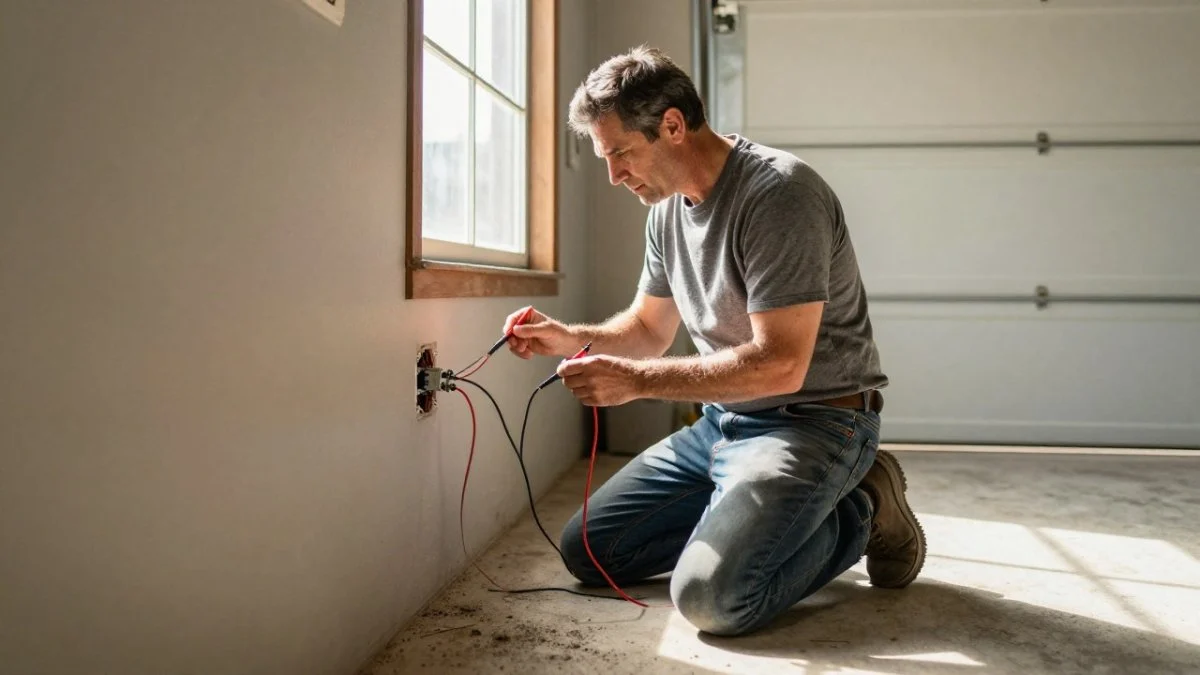
Last Updated: November 26, 2026
Quick Summary
To test voltage drop at home, measure voltage at the source and again at the load while the circuit is running, then subtract the load reading from the source reading. The difference is your voltage drop, and a low reading under load points to resistance somewhere in the circuit.
- Set the meter to AC volts for household circuits and DC volts for battery work.
- Never open a breaker panel; test only at outlets, fixtures, and accessible terminals.
- An open circuit shows near full voltage even when the wiring is bad, so always test under load.
- Keep voltage drop under about 3 percent on a branch circuit and roughly 5 percent total.
- Call a licensed electrician if readings swing wildly or you see heat, scorch marks, or a burning smell.
Table of Contents
- How to test voltage drop at home
- What voltage drop actually means
- Household AC versus low-voltage DC: which one are you testing?
- Safety limits before you touch a meter
- How to test voltage drop with a multimeter
- How to check voltage at an outlet
- Voltage drop over 100 feet of wire
- Voltage fluctuation in house: causes and what readings tell you
- When to call a licensed electrician for voltage drop
- Book a professional voltage drop inspection
- Frequently Asked Questions
How to test voltage drop at home
Voltage drop is the loss of voltage as current travels through wire, connections, and terminals, and you can test it at home by measuring voltage at the source, then again at the load while the circuit is running.
Before you start, it is important to understand that household AC can hurt you. Below, we show you exactly how to test safely, which circuits you can touch, and when to stop and call a licensed electrician.
What voltage drop actually means
Voltage drop is the difference between the voltage supplied to a circuit and the voltage that reaches the load.
Think of it like water pressure in a long hose. The pressure at the tap is fine. At the far end, it fades.
Three things drive it:
- Wire length. The longer the run, the more drop.
- Wire gauge. Thin wire resists more current.
- Connection quality. Corroded terminals and loose screws add resistance.
Here is the key distinction. A voltage measurement tells you what is present. A voltage drop test tells you what is lost while the circuit works.
Household AC versus low-voltage DC: which one are you testing?
You are testing household AC if the circuit runs from your breaker panel to outlets, switches, or appliances.
The two tests look similar. The risk is not.
Household AC at 120 or 240 volts can kill you. Low-voltage DC on a car battery is far safer, though a short can still burn you or start a fire.
For a beginner, start with DC practice if you want to learn meter handling. Then move to AC only after you understand the safety limits in the next section.
Safety limits before you touch a meter
Electricity does not care how careful you feel. Set limits before you start.
- Never open a breaker panel. Panel work belongs to a licensed electrician.
- Test only at outlets, fixtures, and accessible terminals.
- Wear safety glasses and use insulated tools.
If a reading looks wrong and you are not sure why, stop. For context on the site’s licensing and professional disclaimer, review that page before relying on any electrical safety guidance. Guessing at live wiring is how people get hurt.
How to test voltage drop with a multimeter
To test voltage drop with a multimeter, measure voltage at the source and again at the load while the circuit is under load, then subtract the second reading from the first. The difference is your voltage drop.
Here is the tool list you need:
- A digital multimeter rated for the voltage you are testing (CAT III 600 V or better for household AC)
- Insulated test leads in good condition, with no cracks at the strain relief
- A known working load for the circuit (a lamp, a small appliance, or a plug-in load bank)
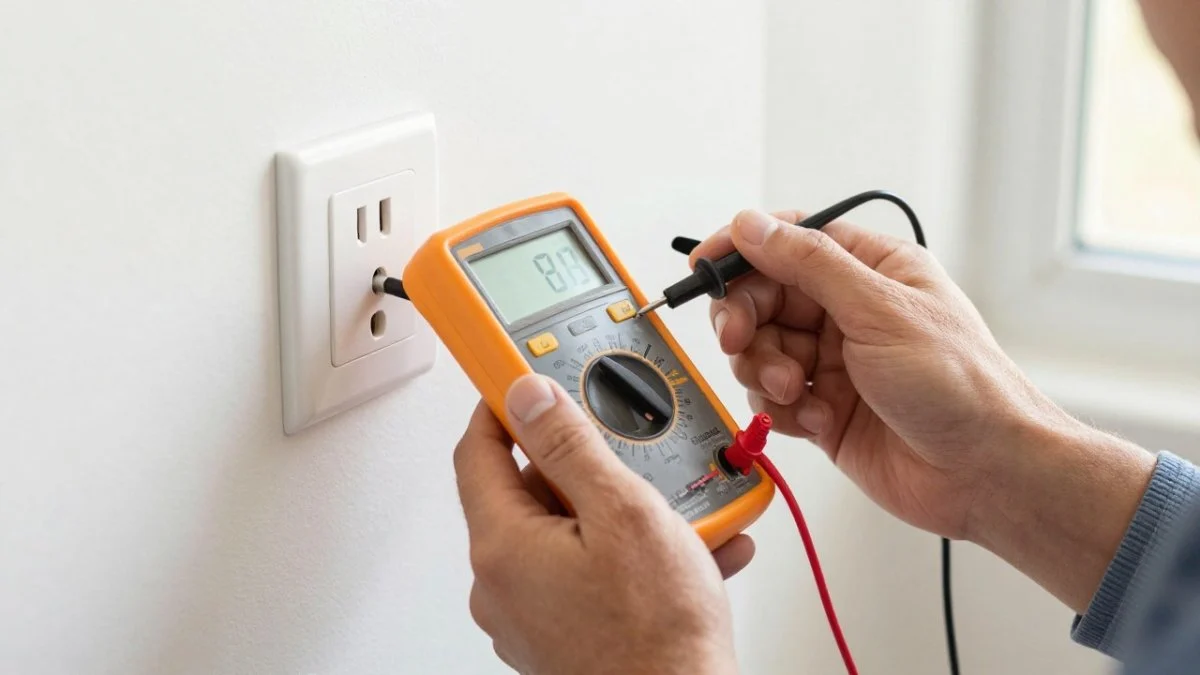
Meter setup and probe placement
Set the dial to AC volts for household circuits, or DC volts for battery work. Plug the black lead into COM and the red lead into the voltage jack (often labeled V, VΩ, or VΩmA).
Probe placement matters more than most people think:
- Black probe goes to neutral or ground.
- Red probe goes to the hot or positive side.
- Both probes must sit firmly on clean metal, not on paint or insulation.
A loose probe gives you a fake reading. That is the most common mistake we see. Press until the tip bites the metal, hold steady, and read the display after it settles.
Reading the display and spotting an invalid result
A valid reading is steady and close to what you expect. An invalid reading looks like one of these:
- 0.0 V on a live circuit. Usually a probe not making contact, a lead in the wrong jack, or a blown meter fuse.
- OL or a flashing over-range symbol. The dial is on the wrong function or range; switch to a higher AC range.
- A number that jumps wildly. Poor probe contact, a loose lead, or a load that is cycling on and off.
Watch out: if the meter reads 0.0 V on a circuit you know is live, check the meter fuse and lead jacks before you assume the circuit is dead.
Testing under load, not on an open circuit
An open circuit, with nothing running, will show you almost full voltage even when the wiring is bad.
Turn on the device or plug in a load. Then measure again at the same test point.
Compare the two numbers directly:
- Measure at the panel-side source.
- Measure at the load end with the device running.
- Subtract to find the drop.
That gap is your answer. If the gap is small and steady, the circuit is likely fine.
Here is the meter setup and reading guide the article walks through, from probe placement to spotting a false result.
| Item | What to do | Watch out for |
|---|---|---|
| Meter dial | Set to AC volts for household, DC volts for battery | Wrong function gives OL or over-range |
| Lead jacks | Black in COM, red in voltage jack | Current jacks can blow fuse or short circuit |
| Probe placement | Black to neutral or ground, red to hot or positive | Loose probe gives a fake reading |
| Reading 0.0 V on live circuit | Check meter fuse and lead jacks | Do not assume the circuit is dead |
| Testing under load | Measure source, then load with device running | Open circuit shows near full voltage even when wiring is bad |
| Finding the drop | Subtract load reading from source reading | Gap that grows with load means resistance |
How to check voltage at an outlet
Checking voltage at an outlet takes about a minute and tells you whether power is reaching it properly.
- Hot slot is the shorter vertical slot. Red probe here.
- Neutral slot is the longer one. Black probe here.
- Ground hole is the round one below.
You should read close to full household voltage. A reading that is well below normal, or that bounces, points to a problem upstream.
Watch out: never force a probe into a slot. If the probes do not fit cleanly, stop and use a plug-in tester instead.
Voltage drop over 100 feet of wire
Long runs are where voltage drop gets serious. A circuit that performs fine at 20 feet can sag badly at 100 feet, especially with thin wire and a heavy load.
A long branch circuit carrying a heavy load can show significant voltage drop, because the round-trip wire length adds resistance. Thicker wire has lower resistance per foot than thinner wire, so it drops less voltage over the same distance.
Calculating and interpreting percentage voltage drop
To find percentage voltage drop, divide the drop by the source voltage, then multiply by 100.
Work it through with a second example. For example, a 4.5-volt drop measured on a 121-volt source works out to about 3.7 percent.
A common benchmark is to keep voltage drop under about 3 percent on a branch circuit and under roughly 5 percent total from the panel to the farthest outlet. Treat those as general design targets, and confirm current requirements with a licensed electrician.
To interpret your numbers, you also need to know the circuit load. If you want to work through the math yourself, see our guide on calculating circuit load at home.
A quick interpretation guide:
- Under 3 percent at the farthest outlet under load. The circuit is behaving normally; no action needed.
- 3 to 5 percent. Marginal. Check connections and confirm the wire gauge matches the breaker size.
- Over 5 percent, or a drop that grows with load. Resistance is real and worth finding before it becomes heat.
Watch out: a voltage drop reading taken with no load, or with a load much smaller than the circuit’s normal load, will look fine even when the wiring is failing.
Voltage fluctuation in house: causes and what readings tell you
Flickering lights when a big appliance kicks on is the classic sign of voltage fluctuation. The compressor in an AC unit draws a surge of current at startup, and a weak circuit cannot hold voltage steady.
Common causes:
- Loose connections at outlets or the panel
- Undersized wire for the load
- Corroded terminals
Dimming lights when the AC starts is worth taking seriously. If you want the full breakdown of causes and fixes, read our article on why lights dim when AC starts.
When to call a licensed electrician for voltage drop
Call a licensed electrician when voltage drop shows up at multiple outlets, when readings swing wildly, or when you see heat, scorch marks, or a burning smell. Those are not DIY problems.
Also call if:
- The drop is over your target percentage after you check the load
- Breakers trip when appliances run together
- You have aluminum wiring or an older panel
If you are unsure how to vet and hire a qualified electrician, our guide on hiring a professional for electrical safety inspections walks through what to ask and what to expect.
Book a professional voltage drop inspection
Testing gets you data. A licensed electrician turns that data into a safe fix.
Our licensed and insured electricians have over 31 years of combined industry experience, and we provide code-compliant electrical services across the Tampa Bay area. If you are ready to book, our guide on how to hire a licensed electrician covers the hiring process from first call to final inspection.
A multimeter can tell you something is wrong, but it cannot tell you why. Contact Accurate Electric LLC to discuss your electrical concerns with a licensed electrician.
Voltage drop testing is a skill worth learning for basic checks, but it has limits. When readings point to a real wiring fault, bring in a licensed electrician who can trace it safely.
Frequently Asked Questions
Can you test voltage drop with a digital multimeter?
Yes. A digital multimeter measures the voltage difference between two points while the circuit is under load. Set the meter to AC volts for household circuits, place one probe at the source and the other at the load, and compare the reading to the source voltage. A drop of more than 3% on a branch circuit or 5% total from the panel signals a problem worth investigating. Never test live wiring unless you are comfortable with basic electrical safety.
How much voltage drop is normal over 100 feet of wire?
Common design targets keep voltage drop under about 3% on a branch circuit and under roughly 5% total from the panel to the farthest outlet. Longer runs, smaller wire, or heavier loads increase drop quickly. If your reading climbs past 5%, the wire gauge may be undersized for the distance.
What does a high voltage drop reading mean?
A high reading means resistance is building up somewhere between your test points. Common culprits include loose terminal screws, corroded connections, undersized wire for the run length, or a failing device on the circuit. In a house with aluminum wiring, oxidized connections are a frequent cause. If the drop appears only when a specific appliance runs, the problem is often at that outlet or the wiring feeding it. Persistent high readings deserve a professional inspection.
When should you call an electrician about voltage drop?
Call a licensed electrician if you measure more than 5% drop at any outlet, notice flickering lights or warm outlets, or cannot locate the source after basic checks. Also call if your home has aluminum wiring, a Federal Pacific or Zinsco panel, or any burning smell near an outlet. A multimeter reading alone cannot resolve these conditions. A professional can trace the circuit, tighten or replace connections, and confirm the fix under load.













continue reading
Related Posts

Learn what a home EV charger install really costs, from panel upgrades to wiring distance, and how to compare quotes before you commit.
Hiring a licensed electrician for panel upgrades starts with the right questions. Learn what a quote should include, how permits work, and what to verify.
A 100 amp panel can support a heat pump in many homes, but existing loads decide it. Learn how the load calculation works and when an upgrade is needed.
Get Social