



Last Updated: November 21, 2026
Quick Summary
The cost to replace outdated home wiring in Tampa depends on home size, access, wiring type, and panel condition, so no flat rate is published. A written estimate after an inspection is the only figure worth budgeting against, and it should itemize labor, materials, permits, and drywall repair separately.
- A 1,500-square-foot full rewire planning estimate includes labor of $6,000 to $9,000 and materials of $2,500 to $4,000.
- Rewiring without removing drywall is often possible by fishing cable through cavities and cutting limited access holes.
- Federal Pacific and Zinsco panels and 100-amp service often make a panel upgrade part of the rewire scope.
- Knob-and-tube wiring typically requires a full rewire, while early Romex may need only partial replacement.
- Confirm the inspection is signed off before walls are closed and patched to avoid rework bills.
Table of Contents
- Why Outdated Home Wiring in Tampa Costs More Than You Think
- Cost to Replace Outdated Home Wiring Tampa per Square Foot
- Using a Cost to Replace Outdated Home Wiring Tampa Calculator
- Rewiring Without Removing Drywall: What Tampa Homeowners Should Know
- Electrical Panel Upgrade Cost Tampa: When It’s Required and What It Adds
- Wiring Types and Replacement Scope: Knob-and-Tube, Aluminum, and Early Romex
- What Happens During a Whole-House Rewire and How Long You’ll Be Without Power
- Getting a Quote from Accurate Electric LLC: What to Prepare and What to Ask
- Frequently Asked Questions
Why Outdated Home Wiring in Tampa Costs More Than You Think
The cost to replace outdated home wiring Tampa homeowners face rarely matches the number they had in mind. That gap comes from scope, not from inflated labor rates. A house built in 1955 and a house built in 1985 can both have “old wiring,” but only one of them likely needs a full rewire.
The sticker shock often traces back to something the homeowner could not see, like aluminum branch circuits, a Federal Pacific or Zinsco panel, or attic runs baked brittle by decades of heat.
Here is the part most guides get wrong. They quote a single “average” figure and never explain that a partial rewire and a whole-house rewire are different projects with different price structures.
Cost to Replace Outdated Home Wiring Tampa per Square Foot
Pricing for a full rewire depends on the size of the home, access, wall material, and panel condition. Accurate Electric LLC has not published fixed pricing, so the only figure worth budgeting against is a written estimate after an inspection.
The main variables that move the number:
- Home size and room count: more rooms mean more outlets, switches, and lighting circuits, and a kitchen or laundry addition adds dedicated circuits that a bedroom does not
- Wall material and access: drywall opens and patches easily; plaster and block do not, and a finished ceiling with no attic above forces invasive work
- Existing wiring type: knob-and-tube and aluminum cost more to remove and replace than early Romex, and aluminum may require approved repair methods at each connection rather than simple replacement
- Panel condition: a panel replacement or service upgrade adds scope, and a 100-amp service or a discontinued panel brand usually means the panel line item is not optional
- Permits and inspection: required on virtually every rewire, and the permit and inspection sequence affects scheduling as much as budget
Itemized sample estimate: 1,500-square-foot single-story home, full rewire
To show how the pieces add up, here is how a realistic total is built rather than presented as one disconnected range. These are planning figures for a straightforward home with drywall, attic access, and a crawlspace, and they will move with condition and access:
| Line item | What it covers | Planning range |
|---|---|---|
| Labor | Licensed electrician hours for rough-in, trim-out, and testing | $6,000-$9,000 |
| Materials | Cable, boxes, devices, fixtures reconnection | $2,500-$4,000 |
| Panel and service | 200-amp panel replacement and service upgrade, if needed | $2,000-$3,500 |
| Permit and inspection | Permit fees and inspection coordination | $300-$700 |
| Drywall repair and paint | Patching access holes and blending paint | $800-$2,500 |
| Cleanup and haul-away | Debris removal and final cleanup | $200-$500 |
Planning range
A home that needs no panel work and has easy access can land near the bottom of those bands; a block home with plaster walls, a Federal Pacific or Zinsco panel, and aluminum branch circuits can exceed the top of every line. The point of itemizing is that you can see which line is driving your total and ask about it directly, instead of comparing one lump sum to another.
Because every home is different, pricing is not published as a flat rate. A written estimate after an inspection is the only figure worth budgeting against, and it should show these same line items separately so you can compare like for like.
Using a Cost to Replace Outdated Home Wiring Tampa Calculator
Online calculators are a starting point, not a quote, and their output can differ from actual scope on a home with plaster walls or hidden aluminum.
Use a calculator to set a rough range, then treat the inspection as the real number. When you compare estimates, ask each contractor to itemize labor, materials, permit fees, drywall repair, and fixture reconnection separately. A single lump sum hides the scope differences that matter most.
Rewiring Without Removing Drywall: What Tampa Homeowners Should Know
Rewiring without removing drywall is possible in many homes, and it is often the difference between a project that fits the budget and one that does not. Electricians fish new cable through existing cavities, use attic and crawlspace runs, and cut limited access holes rather than opening whole walls.
That said, it is not always feasible. Block construction, plaster over lath, and finished ceilings with no attic above can force more invasive work. In those homes, drywall repair becomes a real line item, and you should budget for patching and paint.
A common mistake is assuming a “no-drywall” rewire means no mess. Expect some openings, dust control, and patching regardless. The goal is fewer and smaller holes, not zero.
Electrical Panel Upgrade Cost Tampa: When It’s Required and What It Adds
An electrical panel upgrade is often required alongside a rewire, especially in older homes still running 100-amp service or a discontinued panel brand. Federal Pacific and Zinsco panels are two common older panel brands that replacement typically addresses.
A panel upgrade adds capacity for modern loads: EV chargers, generators, heat pumps, and dedicated circuits. It also gives the new wiring a safe, code-compliant home. For a detailed breakdown of what a panel project involves, see our guide to the cost of an electrical panel upgrade so you can plan both line items together.
Watch out: skipping the panel because the wiring looks fine can leave a new rewire connected to a panel that cannot safely carry it. That is money spent twice.
Wiring Types and Replacement Scope: Knob-and-Tube, Aluminum, and Early Romex
Scope depends heavily on what is actually in the walls. Here is how the three common older wiring types compare.
| Wiring Type | Typical Era | Main Concern | Replacement Scope |
|---|---|---|---|
| Knob-and-tube | Pre-1950s | Brittle insulation, no ground | Full rewire, often invasive |
| Aluminum branch wiring | 1965-1970s | Connection overheating | Full replacement or certified repair |
| Early Romex | 1950s-1980s | Aging insulation, limited grounding | Partial or full, depends on condition |
Aluminum wiring deserves special attention (CPSC Safety Recommendations For Aluminum Wiring In Homes). It can be made safe with approved repair methods rather than a full replacement in some cases (May Is National Electrical Safety Month). Our guide to safe aluminum wiring repair methods explains the options so you can decide before committing to a whole-house job.
What Happens During a Whole-House Rewire and How Long You’ll Be Without Power
A whole-house rewire moves in stages, and knowing the sequence is what lets you plan around work, family routines, and any other renovation on the calendar. Here is the order most projects follow.
- Inspection and scope. The electrician opens a representative sample of walls, checks the panel, and confirms what is actually in the walls. This is where aluminum branch circuits, a Federal Pacific or Zinsco panel, or hidden knob-and-tube get identified, and where the written scope is set.
- Permit. The permit is pulled before work begins, and the inspection sequence is scheduled with the work rather than after it. Skipping or delaying the permit is the most common cause of a stalled rewire.
- Panel and service work. If a panel replacement or service upgrade is in scope, it usually happens early so the new circuits have a safe, code-compliant home to connect to.
- Rough-in. New cable is fished through existing cavities, run through the attic and crawlspace, and secured with limited access holes rather than whole-wall openings wherever the construction allows.
- Trim-out and reconnection. Outlets, switches, and fixtures are reconnected, and the new circuits are tested circuit by circuit.
- Inspection. The work is inspected before walls are closed and patched, so any correction happens while the cavities are still open.
- Drywall repair and cleanup. Access holes are patched, paint is blended, and debris is hauled away.
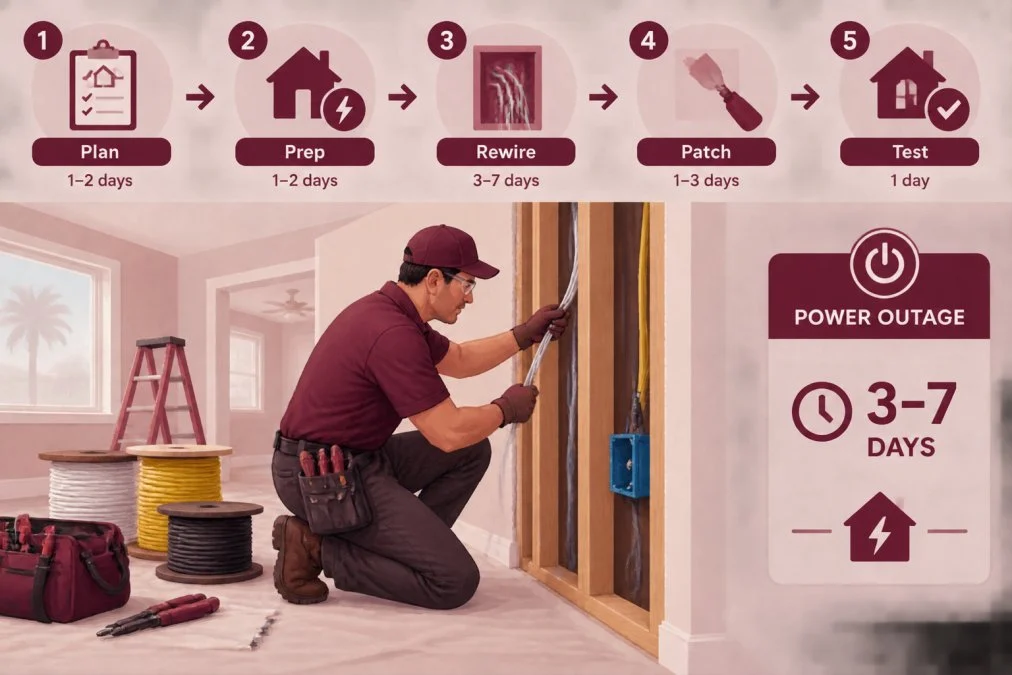
Power shutoffs and living in the home during the work
Power shutoffs are a planning item during the work, particularly for the panel changeover, so coordinate refrigeration, home-office, and medical-equipment needs with your electrician in advance. If the home is occupied, coordinate room access ahead of time so the work can be done in zones.
Timelines vary with home size and access. For a realistic schedule so you can plan around work and family routines, read our breakdown of how long a panel upgrade takes.
Watch out: closing walls before the inspection is signed off is the mistake that turns a smooth rewire into a rework bill, so confirm the inspection is scheduled before any patching begins.
Getting a Quote from Accurate Electric LLC: What to Prepare and What to Ask
A good estimate starts with good information. Before you call, gather the home’s age, square footage, panel brand and amperage, and any known wiring issues like flickering lights or warm outlets. Note any recent additions, EV chargers, or generator plans.
Ask each contractor these questions:
- Are you licensed and insured in Florida?
- Will the estimate itemize labor, materials, permits, and drywall repair?
- Who pulls the permit and handles inspection?
- What is excluded from the quoted scope?
- How will you handle unexpected findings behind the walls?
Comparing scope, not just totals, is how you avoid surprise change orders. If you want to vet a contractor before you commit, our guide on how to hire an electrical contractor you can trust covers licenses, insurance, and estimates. When you are ready to move, you can request a panel and service upgrade quote from our team.
Replacing outdated wiring is a big-ticket project, and the uncertainty around cost is what stops most homeowners from starting. Accurate Electric LLC takes the guesswork out by inspecting first, itemizing the scope, and explaining exactly what your home needs.
Frequently Asked Questions
How much does it cost to rewire a 2,000-square-foot house in Tampa?
The cost of a full rewire depends on wall access, existing wiring type, and whether a panel upgrade is included. Because Accurate Electric LLC has not published fixed pricing, the most accurate way to get a number is to request a detailed quote after an on-site inspection. Expect the estimate to itemize labor, materials, drywall repair, and permit fees separately so you can compare scope fairly.
Can a house be rewired without removing drywall?
Yes, rewiring without removing drywall is often possible, especially in homes with attic or crawlspace access. Electricians use existing cavities, fish tape, and small access holes to pull new cable, then patch and paint those openings afterward. The trade-off is that fishing wire through finished walls takes more labor time than open-wall rewiring, so the method can shift costs from drywall repair toward labor. A qualified electrician will assess your home’s layout and recommend the least invasive approach that still meets code.
Does a whole-house rewire include an electrical panel upgrade?
Not always. A whole-house rewire replaces the wiring throughout the home, while an electrical panel upgrade replaces the main service panel, often to 200-amp service. Many rewire projects include a panel upgrade because older panels like Federal Pacific or Zinsco are safety hazards and may not support modern electrical loads. Ask your contractor to clarify in writing whether the panel replacement is included or quoted as a separate line item.
How long does it take to rewire a house and will I have to move out?
Timelines depend on home size, wiring complexity, and whether walls are opened. Plan for possible daytime outages during specific phases of the work, and ask for a written schedule before work begins. Discussing the timeline upfront helps you coordinate work-from-home needs, food storage, and any medical equipment that relies on electricity.













continue reading
Related Posts
Lightning strikes nearby can fry appliances without ever hitting your home.
Learn how to test voltage drop at home with a digital multimeter. Follow safe, step-by-step checks for outlets, long wire runs, and flickering lights.

Learn what a home EV charger install really costs, from panel upgrades to wiring distance, and how to compare quotes before you commit.
Get Social